Cross-border ecommerce sellers have relied on small-parcel shipping into Europe for years. For Shopify stores, Amazon sellers, TikTok Shop sellers, independent DTC brands, and dropshipping businesses, low-value parcels have been a practical way to test products, serve European customers, and avoid the cost of holding local inventory too early.
That model is changing.
The European Union is moving toward a more unified, data-driven customs system. The reform affects low-value B2C parcels, especially goods imported into the EU with an intrinsic value not exceeding €150. According to the European Commission’s customs reform page, the reform removes the current customs duty relief threshold and introduces a temporary €3 customs duty per item from 1 July 2026 until 1 July 2028. The broader EU customs reform also aims to make online platforms more responsible for customs and VAT obligations, improve data quality, and create a more modern customs architecture through the EU Customs Data Hub.
For ecommerce sellers, this is not just a tax update. It is a business model update.
If you sell to European consumers through Shopify, Amazon, TikTok Shop, Temu-style marketplaces, independent websites, or DTC channels, you need to understand how IOSS, non-IOSS, product identifiers, HS codes, VAT, customs duty, fulfillment routing, and local warehousing may change your cost structure.
This guide explains the 2026 EU low-value parcel customs reform in practical language. It is written for Shopify sellers, DTC brands, private label operators, sourcing teams, and cross-border ecommerce businesses that want to prepare before the rules affect daily operations.
This article is for general information only and is not legal, customs, or tax advice. Sellers should confirm details with customs brokers, tax advisors, logistics providers, and official EU sources before changing compliance processes.
Why the EU Is Changing Low-Value Parcel Rules

The Growth of Low-Value Ecommerce Parcels
The EU customs reform is partly a response to the huge growth of ecommerce parcels entering Europe. Low-value consignments have become a major part of international trade. Many parcels are shipped directly from non-EU countries to EU consumers, often through postal, express, or commercial lines.
For consumers, this model creates low prices and broad product choice. For sellers, it creates fast market entry. For customs authorities, however, it creates pressure.
Customs officials must process large volumes of small parcels, check product safety, collect VAT and duties, identify under-declared values, and stop restricted or unsafe goods. When parcel volume grows faster than customs systems, the risk of under-declaration, misclassification, unsafe products, and tax leakage grows too.
The European Commission’s EU Customs Reform page explains that the reform responds to increased trade volumes, especially ecommerce, and the need for a more data-driven customs system.
The End of the Old Low-Value Advantage
For many years, low-value ecommerce parcels benefited from simplified treatment. Sellers could ship small parcels directly to consumers with relatively low friction.
That advantage is narrowing.
The reform removes the customs duty relief for goods valued below €150 and introduces a temporary €3 duty per item during the transition period. This means low-value parcels are no longer “invisible” from a duty perspective. Even small orders may need more accurate product data, better HS code classification, and stronger tax planning.
For Shopify and DTC brands, this means product margin calculations must be updated. A product that looked profitable under the old rules may become less attractive after duty, VAT, handling, and compliance costs are included.
From “Ship First” to “Data First”
The old cross-border ecommerce model was often shipment-led. Sellers focused on product cost, shipping line, delivery time, and ad performance.
The new model is becoming data-led.
Customs authorities want better information before goods arrive. Sellers and platforms may need to provide product identifiers, HS codes, accurate descriptions, origin data, seller information, buyer information, VAT details, and logistics data.
This is not only about paying more tax. It is about proving what the product is, where it comes from, how it is classified, and who is responsible.
Timeline of the EU Low-Value Parcel Reform
| Date | Milestone | What Sellers Should Do |
| July 2021 | VAT exemption for low-value imports removed | Understand IOSS and VAT collection at checkout |
| May 2023 | EU Customs Reform proposal published | Start monitoring customs data requirements |
| 21 June 2026 | HS code field becomes mandatory for EU shipments | Complete HS code mapping for EU SKUs |
| 23 June 2026 | FriendDropshipping begins duty pre-collection workflow | Review declaration lines before warehouse processing |
| 1 July 2026 | Temporary fixed duty rule starts | Update pricing, ERP, product data, and shipping policy |
| 30 June 2028 | Temporary rule expected to end | Continue monitoring EU implementation updates |
| 2028 and beyond | More unified customs model expected | Prepare for more digital, data-heavy customs processes |
2021: VAT Exemption for Small Parcels Was Removed
In July 2021, the EU removed the VAT exemption for low-value imported goods up to €22 and introduced the Import One-Stop Shop, commonly known as IOSS. IOSS allows sellers or platforms to collect VAT at checkout for eligible imported goods not exceeding €150 and report it through a simplified system.
This was the first major shift from “low-value parcels are easier” toward “low-value parcels need tax visibility.”
2023: Customs Reform Proposal Published
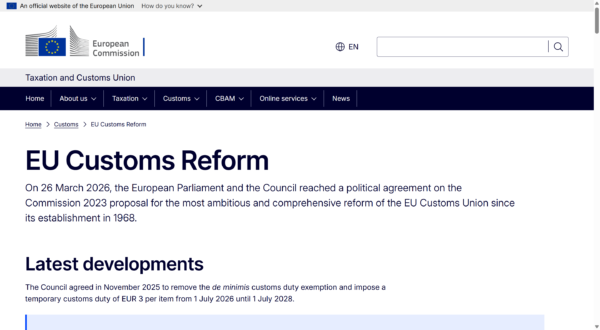
In May 2023, the European Commission published its customs reform proposal. The reform aimed to modernize the EU Customs Union, create a new EU Customs Authority, develop the EU Customs Data Hub, and make ecommerce imports more transparent.
The proposal included the idea of removing the €150 customs duty relief threshold and simplifying duty calculation for ecommerce parcels.
2025-2026: Acceleration Toward Implementation
The reform timeline accelerated as parcel volumes continued to increase. The EU moved from broad policy discussion toward practical implementation measures.
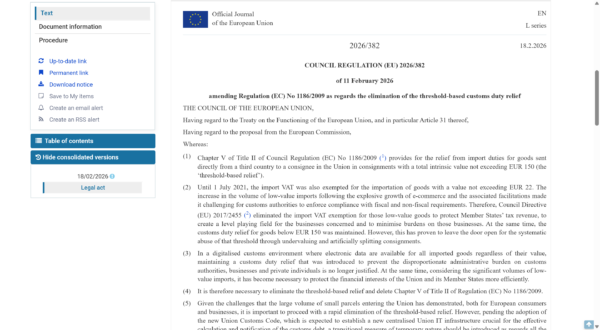
According to the European Commission’s reform page, the Council agreed in November 2025 to remove the de minimis customs duty exemption and introduce a temporary €3 customs duty per item from 1 July 2026 until 1 July 2028.
The official legal reference shown by the Commission is Council Regulation (EU) 2026/382.
2026: Transition Period Begins
From 1 July 2026, the temporary customs duty measure begins. The screenshots you provided describe this as a transition period where low-value B2C parcels under €150 become subject to a €3 item-based duty.
The transition period is expected to push sellers, platforms, customs brokers, and logistics providers to clean up product data, identify product codes, improve customs declarations, and prepare for the longer-term customs model.
2028 and Beyond: A More Unified System
The long-term direction is a more centralized, data-driven customs system. The European Commission describes the EU Customs Data Hub as a future single online environment where businesses can provide product and supply chain information.
For ecommerce sellers, the direction is clear: customs compliance will become more digital, more standardized, and more data-heavy.
What Actually Changes for Low-Value B2C Parcels?
The €150 Customs Duty Relief Is Removed
The most important change is the removal of customs duty relief for goods valued below €150.
Under the old structure, many low-value parcels were exempt from customs duty, although VAT still applied after the 2021 VAT ecommerce changes. Under the new structure, customs duty becomes part of the cost calculation even for low-value B2C parcels.
For sellers, this means product price, landed cost, and margin must be recalculated.
A Temporary €3 Duty Per Item Applies
During the transition period, low-value B2C imported parcels may be subject to a temporary fixed customs duty of €3 per item.
This matters because “item” is not always the same as “parcel.” A parcel containing three T-shirts may create a different duty outcome from a parcel containing one bundled set, depending on how the item is classified and declared. Sellers need to be careful with product bundling, HS codes, and item-level data.
The Duty May Increase the VAT Base
In many import situations, customs duty can become part of the taxable base for VAT calculation. This means the total tax effect may be more than just €3.
For example, if a product has a €3 customs duty and VAT is calculated on the value including duty, the final consumer price or seller margin may be affected further.
This is why sellers should not treat the reform as a simple “add €3” change. The full landed cost should include product cost, international freight, customs duty, VAT, clearance fees, platform fees, payment fees, returns, and customer support costs.
Returns May Become More Expensive
The image materials mention an important operational risk: if returns happen, duties paid may not always be recoverable in a simple or cost-effective way.
For low-margin products, return-related tax and logistics costs can quickly damage profitability. Sellers should review refund policies, return routes, local return addresses, and product categories with high return rates.
IOSS vs Non-IOSS: Why the Model Matters
What Is IOSS?
IOSS stands for Import One-Stop Shop. It is an EU VAT simplification scheme for distance sales of imported goods to EU consumers where the consignment value does not exceed €150.
Under IOSS, the seller or platform collects VAT at checkout and reports it through the IOSS system. The customer can see the VAT-inclusive price at purchase, and import VAT is not collected again at delivery when the IOSS process is used correctly.
The EU’s official VAT One Stop Shop portal provides more information about VAT ecommerce schemes here: VAT One Stop Shop.
Why IOSS Became Popular
IOSS became popular because it improves the customer experience. Consumers do not want surprise tax bills at delivery. If VAT is collected at checkout, the customer knows the total price upfront.
For Shopify and DTC sellers, this can reduce delivery refusal, customer complaints, and post-purchase friction.
What Changes After the Reform?
IOSS remains important for VAT, but customs duty changes affect the economics of low-value parcels. The reform means sellers must think about both VAT and duty, not only VAT.
The screenshots suggest that after the new rules, IOSS parcels may not need destination-country customs clearance in the same way as non-IOSS models, while non-IOSS low-value B2C parcels may face stricter clearance requirements in the consumer’s country.
The practical point is this: IOSS can still simplify VAT handling, but sellers must update duty, HS code, product identifier, and parcel data workflows.
Non-IOSS Model Risks
In a non-IOSS model, VAT and possibly other fees may be collected at import or delivery. This can create a worse customer experience.
Non-IOSS risks include:
-
Unexpected charges for the customer
-
Delivery refusal
-
Longer clearance time
-
More customer service tickets
-
Higher return rates
-
Less predictable landed cost
-
More complex country-level compliance
For low-value DTC sales, customer experience matters. A surprise tax bill can destroy trust even if the product itself is good.
Product Identifiers: The New Data Layer Sellers Cannot Ignore
What Are Product Identifiers?
Product identifiers are codes that help customs, platforms, logistics providers, and supply chain systems identify goods more accurately.
The screenshots mention three types of identifiers:
-
Merchant Product Identifier
-
Manufacturer Product Identifier
-
Standardised Manufacturer Product Identifier
Examples may include internal SKUs, listing IDs, ASINs, manufacturer part numbers, model numbers, GTINs, EANs, UPCs, or other standardized product codes.
Why Product Identifiers Matter
Product identifiers help customs systems understand what the item is. They support product traceability, customs declarations, product safety checks, and future digital compliance systems.
For ecommerce sellers, this is a major shift. A vague product description such as “accessory,” “gift,” “sample,” or “daily use product” will become less acceptable.
Product data needs to be cleaner and more consistent.
What Shopify Sellers Should Prepare
Shopify sellers should start building a product data database that includes:
-
SKU
-
Product title
-
Product description
-
Variant
-
HS code
-
Country of origin
-
Material or ingredient details
-
Unit value
-
Product identifier
-
Manufacturer identifier
-
GTIN, EAN, UPC, or equivalent where available
-
Product image
-
Supplier name
-
Customs declaration name
-
Sales channel listing ID
-
Packaging quantity
-
Bundle structure
This database should connect product sourcing, Shopify listings, logistics, customs declarations, and fulfillment.
Product Identifiers and Digital Product Passport Direction
The screenshot also connects product identifiers with the EU’s broader digital compliance direction, including Digital Product Passport concepts. While the timing and product scope may differ by category, the direction is clear: Europe is moving toward better product-level traceability.
Sellers who clean their data early will be in a stronger position than sellers who wait until platforms require it.
HS Codes and Product Classification Become More Important

What Is an HS Code?
An HS code is a standardized customs classification code used to identify products in international trade. The first six digits are internationally harmonized, while additional digits may vary by country or region.
HS codes help determine:
-
Customs duty
-
Import restrictions
-
VAT treatment
-
Product category
-
Regulatory requirements
-
Customs risk review
Incorrect HS codes can lead to delays, extra duty, fines, shipment holds, or account-level platform issues.
Why HS Codes Matter More After 2026
When low-value parcels were treated more lightly, many sellers did not pay enough attention to HS code accuracy. After the reform, item-level duty and data requirements make HS code discipline more important.
If a seller declares a product under the wrong HS code, the duty calculation may be wrong. If customs systems compare product identifiers, descriptions, and HS codes, inconsistencies may increase inspection risk.
Important Notice: HS Code Fields Become Mandatory for EU Shipments
Because HS codes will directly affect EU customs clearance after the tax reform, FriendDropshipping recommends sellers prepare accurate HS codes before shipping EU orders.
Important operational notice: From 10:00 AM on 21 June 2026, the system will set the customs code field for EU countries as a mandatory field. For future EU shipments, sellers should enter accurate HS codes when submitting orders.
To obtain accurate HS codes, sellers can refer to the European Commission TARIC consultation tool:
This notice matters because HS codes affect:
-
Whether products can be merged into one declaration line
-
Whether products are classified correctly
-
How customs authorities calculate duties
-
Whether parcels face re-declaration or extra charges
-
Whether EU customs clearance is delayed
-
Whether a parcel is held, returned, destroyed, or charged again
Build an HS Code Review Workflow
A practical HS code workflow should include:
-
Product classification by category
-
Supplier information review
-
Material or composition details
-
Use case review
-
Customs broker confirmation
-
Country-specific duty review
-
Internal SKU mapping
-
Periodic review when products change
FriendDropshipping’s Sourcing and Fulfillment service can support sellers who need better coordination between product sourcing, product descriptions, and logistics data before shipping to Europe.
Cost Impact: Why €3 Is Bigger Than It Looks
The Duty Is Item-Based
The screenshots show a simple but important point: the cost impact depends on how many items are in the parcel.
If a parcel contains multiple items, duty may multiply. A €3 item-based duty can become €6, €9, or more depending on item count and classification.
This can affect bundle strategy. A bundle may look attractive from a marketing perspective but become less attractive from a duty perspective if each component is treated as a separate item.
VAT Can Amplify the Cost Increase
If customs duty increases the VAT base, the total cost impact can be higher than the duty itself.
For example, if an item has €3 duty and VAT is 20%, the VAT-related effect may add another cost layer. The screenshots illustrate how even small duty changes can increase the total tax burden.
Low-Margin Products Are Most Exposed
Products with low average order value, low gross margin, high return rate, or heavy discounting are more exposed.
At-risk categories include:
-
Cheap accessories
-
Socks
-
Small fashion items
-
Phone cases
-
Low-price home goods
-
Small gadgets
-
Low-margin bundles
-
Free-plus-shipping offers
-
Heavy discount products
If the gross profit per order is only a few euros, a €3 duty can erase profitability.
Premium and Differentiated Products Are More Resilient
The reform may push sellers toward higher-value, more differentiated products.
Products with stronger branding, higher perceived value, lower return rates, and better margins can absorb new compliance costs more easily.
This is why the screenshots suggest that high-margin, personalized, branded, or differentiated products may become more stable than low-price commodity products.
Fulfillment Models After the EU Reform
Model 1: Direct B2C Shipping With IOSS
Direct B2C shipping with IOSS can still work for many sellers, especially those selling high-margin, lightweight, low-return products.
This model may be suitable for:
-
Independent Shopify sellers
-
DTC brands testing Europe
-
High-value small products
-
Niche products
-
Single-category stores
-
Brands with strong product data
-
Sellers able to collect VAT at checkout
Advantages include lower inventory commitment, direct delivery to customers, and simpler early-stage testing.
Challenges include customs duty cost, item-level data requirements, product identifier preparation, return handling, and possible customer experience issues if data is wrong.
FriendDropshipping’s Shipping Solution can help sellers evaluate cross-border routes and prepare more reliable shipping workflows for EU customers.
Model 2: B2B2C With Overseas Warehouse
A B2B2C model means goods are first shipped in bulk to an overseas warehouse, then delivered locally to consumers after orders are placed.
This model may be suitable for:
-
Brands with stable demand
-
Products with predictable sales volume
-
Sellers with EU VAT/EORI preparation
-
High-return categories
-
Brands needing faster delivery
-
Sellers wanting local delivery experience
Advantages include better delivery speed, more local control, and potentially smoother customer experience.
Challenges include inventory commitment, warehouse cost, local VAT obligations, customs clearance planning, and cash flow pressure.
Model 3: Pre-Sale + Overseas Warehouse Direct Shipping
The screenshots also show a hybrid model: sellers publish pre-sale listings, prepare inventory based on expected demand, ship bulk goods to overseas warehouses, and fulfill locally after orders are confirmed.
This model may work for brands with better demand forecasting and stronger platform data.
Advantages include reduced blind inventory risk, better customer delivery experience, and more controlled customs planning.
Challenges include forecasting accuracy, capital requirements, inventory planning, and operational complexity.
Model 4: Local EU Fulfillment for Mature Brands
For mature DTC brands, local EU fulfillment may become more attractive.
Local fulfillment can reduce cross-border parcel friction, improve delivery speed, simplify returns, and create a better customer experience. However, it also requires local tax, import, warehouse, and compliance planning.
This model is usually better for brands with proven European demand.
How Different Sellers Should Respond
Shopify DTC Brands
Shopify sellers should focus on product data, pricing, and checkout transparency.
Action items:
-
Review EU sales percentage
-
Identify top-selling EU SKUs
-
Map HS codes
-
Prepare product identifiers
-
Review IOSS setup
-
Update landed cost model
-
Check VAT collection process
-
Improve product descriptions
-
Review return policy
-
Prepare EU-friendly shipping routes
A Shopify seller with clean product data and transparent pricing will be in a stronger position than a seller relying on vague declarations and low-cost shipping only.
Amazon Sellers
Amazon sellers should watch platform requirements closely. The screenshots mention that platforms may require stronger product identifier data, such as ASIN and manufacturer-related identifiers.
Amazon sellers should ensure product listings, manufacturer identifiers, HS codes, and customs data are aligned.
Marketplace Sellers
Sellers on marketplaces should prepare for platform-driven compliance changes. Platforms may update listing requirements, customs fields, product identifier requirements, and shipping templates.
The risk is not only customs delay. Listings may lose visibility or become non-compliant if required product data is missing.
Dropshipping Sellers
Traditional dropshipping models may face more pressure.
Low-cost products, weak data, vague declarations, and long delivery times will become less competitive. Dropshipping sellers should move toward more controlled sourcing, better data, stronger product selection, and more reliable fulfillment.
FriendDropshipping’s Quality Control service can help sellers reduce avoidable product and packaging problems before parcels enter cross-border shipping channels.
How to Prepare Your Product Database Before 2026 Rules Bite

Build a Master SKU File
Every seller shipping to Europe should build a master SKU file.
Include:
-
SKU
-
Product name
-
Variant
-
English customs description
-
HS code
-
Country of origin
-
Material
-
Usage
-
Unit value
-
Weight
-
Dimensions
-
Manufacturer name
-
Product identifier
-
GTIN/EAN/UPC if available
-
Listing ID
-
Product image
-
Supplier contact
-
Declared value logic
-
Bundle relationship
-
Packaging type
This file should be shared across sourcing, Shopify, fulfillment, logistics, and customs teams.
Standardize Product Descriptions
Avoid vague descriptions.
Weak descriptions:
-
Gift
-
Accessory
-
Daily item
-
Clothes
-
Parts
-
Sample
-
Beauty tool
-
Better descriptions:
-
Men’s cotton T-shirt
-
Stainless steel water bottle
-
Silicone phone case
-
Women’s ankle socks
-
Plastic kitchen storage box
-
LED desk lamp
-
Ceramic coffee mug
Better descriptions reduce customs ambiguity.
Connect Data to Fulfillment
Product data should not stay in a spreadsheet that nobody uses. It should connect to fulfillment operations.
When warehouse teams pack orders, logistics providers declare shipments, and customs brokers process parcels, they should use the same SKU and product data.
FriendDropshipping’s Sourcing and Fulfillment workflow can help ecommerce sellers connect product sourcing information with order fulfillment and shipping execution.
Pricing Strategy Under the New EU Rules

Recalculate Landed Cost
Do not price European orders based only on product cost and shipping cost.
Include:
-
Product cost
-
Packaging cost
-
International freight
-
Customs duty
-
VAT
-
Platform fees
-
Payment fees
-
Fulfillment fees
-
Return cost
-
Replacement cost
-
Customer support cost
-
Ad cost
-
Currency fluctuation
The real profit per order may be lower than expected.
Consider Raising Prices Before the Deadline
The screenshots suggest sellers should consider adjusting online prices in advance.
This is smart. If you wait until the rule change begins, customers may notice a sudden price jump. Gradual price testing gives sellers more data and reduces shock.
Use Bundles Carefully
Bundles can increase average order value, but after the reform they may create higher item-based duty.
Review whether a bundle should be:
-
Sold as separate items
-
Sold as a kit
-
Declared as multiple items
-
Declared as one set
-
Shifted to local warehouse fulfillment
-
Priced higher
-
Repackaged as a premium product
-
Customs classification should be confirmed with professionals.
Shift Away From Low-Margin Commodity Products
If a product cannot survive the new duty and VAT structure, it may not be worth scaling in Europe.
The reform may push sellers toward:
-
Higher-margin products
-
Private label goods
-
Niche categories
-
Personalized products
-
Branded bundles
-
Products with lower return rates
-
Products with better customer loyalty
Platform and Logistics Response Strategies
Platforms Will Require Better Data
Marketplaces and ecommerce platforms are likely to require more complete product and customs data. This may include product identifiers, HS codes, origin information, and shipment-level data.
Sellers who prepare early will have less friction when these fields become mandatory.
Logistics Providers Will Tighten Declarations
Logistics providers may reject vague product descriptions or incomplete data. They may require sellers to provide HS codes, product identifiers, and accurate item values before accepting shipments.
This means shipping preparation must start earlier in the order workflow.
Customs Brokers Will Become More Important
For sellers with meaningful EU volume, customs brokers and tax advisors will become more valuable. They can help with classification, duty treatment, VAT registration, IOSS setup, EORI, import strategy, and local compliance planning.
Data Quality Becomes a Competitive Advantage
In the old model, speed and low shipping cost were major advantages.
In the new model, data quality becomes part of logistics performance. Sellers with clean product data may experience fewer holds, fewer corrections, and smoother customs processing.
FriendDropshipping Execution Plan and Declaration Requirements
To help sellers adapt to the new EU customs duty rule, FriendDropshipping will adjust EU parcel declaration and duty collection workflows.
Pre-Collection Timing
For EU-bound parcels, FriendDropshipping will start pre-collecting the fixed duty during the warehouse weighing and verification stage.
According to the operational notice, pre-collection begins at:
10:00 AM on 23 June 2026
The pre-collection amount will be calculated based on:
number of product declaration lines in the parcel x EUR 3
If parcels entering the warehouse between 10:00 AM on 23 June 2026 and 10:00 AM on 25 June 2026 complete EU customs clearance before 1 July 2026, the corresponding pre-collected customs duty will be refunded.
Customs Payment Stage
The customs duty is paid during customs clearance through the customs broker’s supervised customs account. Goods can be released only after the required payment is completed.
This means cash flow timing matters. Sellers should not wait until parcels are blocked at customs to calculate duty impact.
Declaration Data Requirements
Sellers should prepare cleaner declaration data before submitting EU orders.
Key requirements include:
-
Merge similar products in the same parcel when the first 6 digits of the HS code are the same.
-
Use accurate Chinese and English product names where applicable.
-
Do not include unnecessary model, color, or descriptive words in the declaration product name.
-
Use clear product names such as “plastic cup” instead of long marketing-style descriptions.
-
Do not omit items from the declaration.
-
Do not incorrectly merge different HS codes.
-
Do not use false or vague product descriptions.
All duties are ultimately based on the actual declaration lines accepted or adjusted by customs. If missing declarations, incorrect HS code merging, or wrong classification cause customs to re-declare and generate extra charges, the seller is responsible for the difference.
How FriendDropshipping Can Help Cross-Border Sellers Prepare

Shipping Route Planning
The EU reform makes shipping route selection more important. Sellers need routes that can support accurate declarations, IOSS or non-IOSS handling, customs data, and reliable tracking.
FriendDropshipping’s Shipping Solution can help sellers compare shipping options and build more stable cross-border delivery plans.
Product Sourcing and SKU Control
The reform increases the importance of product data at the sourcing stage. If a supplier cannot provide accurate product names, materials, origin, packaging details, or identifiers, the seller may struggle later.
FriendDropshipping’s Sourcing and Fulfillment service can help sellers organize sourcing information before it becomes a customs problem.
Quality Control Before Export
Product and packaging issues should be caught before shipment.
FriendDropshipping’s Quality Control service can help check product condition, packaging, labels, quantities, and visible defects before goods are shipped internationally.
Custom Packaging and Private Label Preparation
As low-margin commodity products face more pressure, private label and branded packaging become more valuable.
FriendDropshipping’s Customization & Private Pack service can help sellers prepare branded packaging, inserts, labels, and bundle presentation for higher-value DTC offers.
Practical Checklist for Shopify and DTC Sellers

Product Data Checklist
Prepare:
-
SKU
-
HS code
-
Product identifier
-
Manufacturer identifier
-
GTIN/EAN/UPC if available
-
Product description
-
Country of origin
-
Material
-
Unit value
-
Product weight
-
Product image
-
Supplier details
-
Bundle structure
-
Declared item count
Tax and Customs Checklist
Review:
-
IOSS setup
-
VAT collection at checkout
-
EORI needs
-
Destination country VAT rules
-
Customs duty impact
-
Return duty treatment
-
HS code accuracy
-
Import model
-
DDP/DDU strategy
-
Customs broker support
Fulfillment Checklist
Check:
-
Warehouse location
-
Shipping route
-
Tracking reliability
-
Product packaging
-
Label accuracy
-
Bundle assembly
-
Return address
-
Local warehouse option
-
Quality control process
-
Shipping documentation
-
Customer notification flow
Pricing Checklist
-
Recalculate:
-
Product margin
-
Duty impact
-
VAT base
-
Shipping cost
-
Return cost
-
Ad cost
-
Platform fees
-
Customer support cost
-
Bundle profitability
-
EU-specific price points
What Sellers Should Do Now
The cost impact is easiest to understand with a comparison chart. The table below uses simplified examples and does not include product cost, shipping fee, payment fee, or platform fee. VAT is shown only to explain how the taxable base may change when customs duty is added.
| Order Scenario | Declared Goods Value | Declaration Lines | Fixed Duty | Example VAT Rate | VAT Before Fixed Duty | VAT After Fixed Duty | Total Tax/Duty Increase |
| Low-ticket single item | EUR 7 | 1 | EUR 3 | 20% | EUR 1.40 | EUR 2.00 | EUR 3.60 |
| One parcel, same HS code items | EUR 30 | 1 | EUR 3 | 20% | EUR 6.00 | EUR 6.60 | EUR 3.60 |
| Mixed parcel, 3 declaration lines | EUR 30 | 3 | EUR 9 | 20% | EUR 6.00 | EUR 7.80 | EUR 10.80 |
| Higher-value order, 1 declaration line | EUR 80 | 1 | EUR 3 | 20% | EUR 16.00 | EUR 16.60 | EUR 3.60 |
Clean Up Product Data Immediately
Do not wait until rules become painful. Start with your top-selling EU SKUs and clean product data now.
Review EU Profitability by SKU
Some products may remain profitable. Others may become weak. Analyze SKU-level profitability instead of using average store margin.
Test Price Adjustments Early
Try gradual price testing before the rule change becomes visible to customers.
Decide Between Direct Shipping and Local Fulfillment
If Europe is a small test market, direct shipping may still work. If Europe is a major growth region, local fulfillment or hybrid B2B2C models may become more attractive.
Talk to Logistics Partners
Ask your logistics provider what data they will require, how they will handle IOSS, how they will process non-IOSS parcels, and whether they support item-level duty calculation.
Final Thoughts
The 2026 EU low-value parcel customs reform is not just another tax change. It is a signal that cross-border ecommerce is moving from a low-friction parcel model to a more structured, data-driven compliance model.
For Shopify and DTC sellers, the winners will be the brands that prepare early. Clean product data, accurate HS codes, product identifiers, reliable IOSS handling, smarter pricing, better fulfillment, and stronger shipping routes will matter more than ever.
The old question was: “How cheaply can we ship this parcel?”
The new question is: “Can we sell, declare, ship, clear, deliver, and support this product profitably and compliantly?”
Brands that answer that question well will still find opportunity in Europe. But the easy days of vague declarations, low-value loopholes, and thin-margin commodity parcels are ending.
FriendDropshipping can help ecommerce sellers prepare for this new environment through Sourcing and Fulfillment, Shipping Solution, Quality Control, and Customization & Private Pack services designed for cross-border Shopify and DTC brands.
FAQs
What is the 2026 EU low-value parcel customs reform?
The 2026 EU low-value parcel customs reform refers to changes affecting imported ecommerce parcels, especially goods valued under €150. The reform removes the customs duty relief threshold and introduces a temporary €3 customs duty per item from 1 July 2026 to 1 July 2028, according to the European Commission’s customs reform information.
Does the €150 exemption disappear?
Yes, the EU reform removes the customs duty relief for goods valued below €150. VAT rules already changed in 2021, and the new reform adds customs duty pressure to low-value ecommerce parcels.
What is the €3 customs duty?
The temporary €3 customs duty is an item-based duty for certain low-value imported ecommerce parcels during the transition period. Sellers should confirm the exact application with customs brokers and official EU guidance.
Does IOSS still matter after the reform?
Yes. IOSS still matters for VAT collection on eligible imported goods not exceeding €150. However, sellers must also consider customs duty, HS codes, product identifiers, and item-level data after the reform.
What is the difference between IOSS and non-IOSS?
Under IOSS, VAT can be collected at checkout and reported through the IOSS system. In non-IOSS models, VAT and other charges may be collected at import or delivery, which can create surprise charges for customers and increase delivery refusal risk.
What are product identifiers or PIDs?
Product identifiers are codes used to identify products more accurately across platforms, customs systems, logistics providers, and supply chains. They may include SKUs, listing IDs, manufacturer part numbers, GTINs, EANs, UPCs, or ASINs.
Why do HS codes matter more now?
HS codes determine customs classification and duty treatment. As low-value parcels become more closely monitored, inaccurate HS codes can increase the risk of delays, wrong duty calculation, shipment holds, or compliance problems.
How will the EU reform affect Shopify sellers?
Shopify sellers shipping to EU customers may need to update product data, review IOSS setup, calculate new duty and VAT impact, prepare product identifiers, adjust prices, and choose better shipping or fulfillment models.
Will low-cost products become harder to sell in Europe?
Yes, low-cost and low-margin products may become harder to sell profitably because item-based duty, VAT, shipping, returns, and compliance costs can reduce margin.
Should sellers use an EU warehouse?
An EU warehouse may be useful for brands with stable European demand, high order volume, fast delivery expectations, or high return rates. However, local fulfillment also requires VAT, import, inventory, and compliance planning.
What should sellers prepare before July 2026?
Sellers should prepare HS codes, product identifiers, accurate product descriptions, IOSS review, VAT collection workflows, landed cost calculations, shipping route plans, and EU-specific pricing strategies.
How can FriendDropshipping help with EU ecommerce shipping?
FriendDropshipping can support cross-border ecommerce sellers with sourcing, quality control, shipping route planning, custom packaging, and fulfillment workflows for Shopify and DTC brands preparing for EU customs changes.
Table of Content

I’m Cassiel. I’ll help you scale your Shopify business with reliable fulfillment.
Join to newsletter.
Follow us and get more knowledge.