
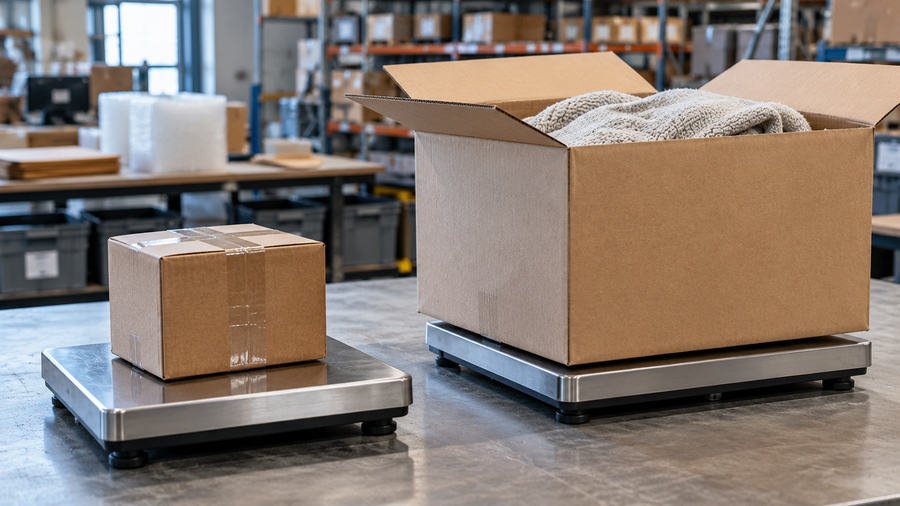
A customer orders a soft travel pillow. The finished parcel weighs five pounds. Then the shipping bill treats it like a fourteen-pound parcel. The scale isn’t broken. The box is simply taking up a lot of room.
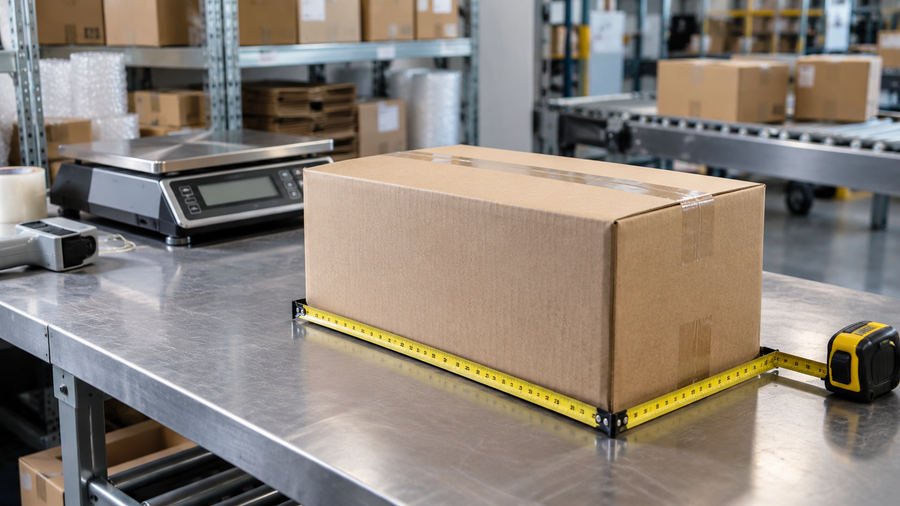
To check that bill, you need the outside dimensions of the finished package, its scale weight, the shipping service, and that service’s dimensional-weight rule. With those inputs, you can calculate an estimated billable weight. You can also test whether a smaller box actually helps.
This guide gives you a worksheet, worked examples, and a way to compare packaging. It does not produce a live carrier quote. A divisor tells you how a carrier converts space into a weight figure; it does not tell you the final shipping price. Keep those two steps apart and the math gets much easier to use.
Calculate the billable weight of a finished parcel
Dimensional weight, also called DIM weight or volumetric weight, turns a parcel’s occupied space into a weight figure. For many parcel services, the carrier compares that figure with the actual packed weight and rates the parcel using the larger applicable value. The exact eligibility and rounding rules still come from the service and your account agreement.
Before touching a calculator, collect these inputs:
| Input | What to enter | Where it comes from |
|---|---|---|
| Length, width, height | Outside measurements of the sealed shipping package, including its widest points | Measured sample pack or fulfillment scan |
| Actual weight | Product plus retail pack, shipping pack, inserts, cushioning and tape | Scale reading for the finished parcel |
| Units | Inches and pounds or centimeters and kilograms | Carrier/service rate rule |
| Divisor | The factor for that service, destination and rate agreement | Carrier guide, platform quote or signed contract |
| Eligibility and rounding | Size threshold, measurement method and weight increment | Applicable service rule |
The basic calculations are:
Cubic size = length × width × height
Raw dimensional weight = cubic size ÷ divisor
Estimated billable weight = the greater applicable, rounded actual or dimensional weight, under that service’s rules.
The unit on the divisor matters. A factor expressed in cubic inches per pound goes with inches and pounds. A factor expressed in cubic centimeters per kilogram goes with centimeters and kilograms. Mixing them produces a lovely clean number that is completely wrong.
An inches-and-pounds example you can check
Suppose your finished carton measures 20 × 15 × 10 inches and weighs 12 pounds. For an illustrative service using a divisor of 139 cubic inches per pound, the cube is 20 × 15 × 10 = 3,000 cubic inches. Raw DIM weight is 3,000 ÷ 139 = 21.58 pounds. If the applicable rule rounds a fractional DIM pound up to a whole pound, the DIM figure is 22 pounds. That exceeds the 12-pound actual weight, so the estimated billable weight is 22 pounds.
The 139 factor is a real published factor in some carrier contexts. It is not permission to paste 139 into every shipment. Check the exact service before you use the result.
A centimeters-and-kilograms example
Now use a package measuring 40 × 30 × 20 centimeters, with an actual packed weight of 1.2 kilograms. With an illustrative 5,000 cm³/kg divisor, volume is 24,000 cm³ and raw volumetric weight is 4.8 kg. DIM is the larger raw number. The billed increment, if any, depends on the chosen service; don’t silently round it to a whole kilogram unless that rule says to.
That example is a useful check for cross-border quotes written in metric units. It also shows why you must measure the shipping box. The product inside could be much smaller than 40 × 30 × 20.
Why two calculators can disagree about the same box
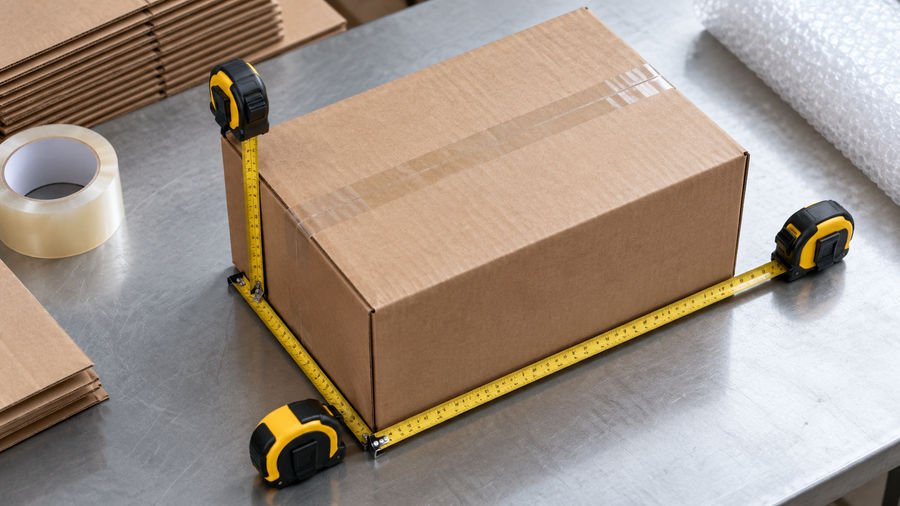
The formula looks simple. The rule wrapped around it is where calculators diverge. One page may apply DIM to every parcel. Another may have a size threshold. One may use a default divisor that does not match your negotiated account. A third may round dimensions at a different stage.
| Rule to check | Why the number changes | What to use for a real shipment |
|---|---|---|
| Divisor | A smaller divisor makes the calculated DIM weight larger | The factor for your carrier, service, destination and rate type |
| Eligibility threshold | A service may not use DIM below a stated cube | Its current service-specific rule |
| Dimension rounding | Fractions can change the cube before division | The carrier’s measurement method |
| Weight rounding | A fractional result may move to a billable increment | The rule for that service and account |
| Final rate and surcharges | Weight alone does not set postage | A quote or invoice for the same origin, destination and date |
For example, UPS’s U.S. dimensional-weight guidance lists 139 for Daily Rates and 166 for Retail Rates. Those are rate types, not interchangeable labels. Your account’s applicable guide or agreement controls the shipment. If the packed carton measures 3,000 cubic inches, division by 139 yields about 21.58 pounds; division by 166 yields about 18.07 pounds. Under a whole-pound-up rule, those become 22 and 19 pounds respectively. Same box. Different input rule.
USPS gives another trap. Its published commercial Ground Advantage rule for applicable domestic zones says the parcel must exceed 1 cubic foot, or 1,728 cubic inches, before that dimensional-weight calculation applies. It directs the sender to round each measurement up to the next whole inch and, for an eligible rectangular parcel, divide the resulting cube by 139 and round the DIM result up. The USPS Ground Advantage rule is specific; do not turn it into a blanket statement about every USPS product.
Take a rectangular 12 × 12 × 12-inch box. Its volume is exactly 1,728 cubic inches. It does not exceed the threshold under that rule. Increase the height to 13 inches, and the cube becomes 1,872 cubic inches. At 139, raw DIM is about 13.47 pounds, or 14 pounds after the stated whole-pound rounding. If the actual packed box weighs five pounds and all other conditions apply, that one-inch change changes the basis of the weight calculation. Quite a leap for one inch, yes.
This is why a generic calculator should be treated as a planning tool. Enter the correct rule. Then check the carrier’s quote before promising a checkout shipping price.
Compare two packaging choices, not just two divisors
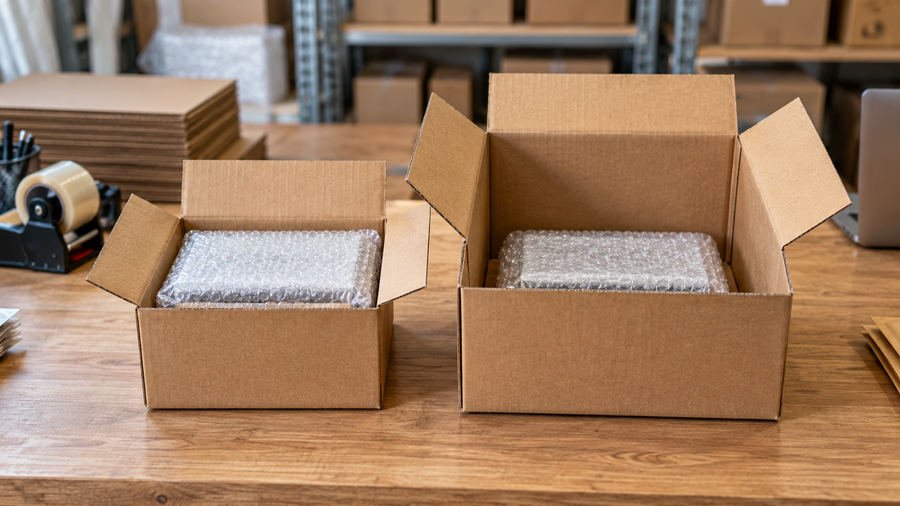
Let’s go back to the 12-pound product in the 20 × 15 × 10-inch carton. Suppose a packing test shows it fits safely in a 16 × 12 × 8-inch carton with the required cushioning. For this example, assume the finished weight remains 12 pounds. That is an assumption for the comparison, not a claim that a smaller box always weighs the same.
| Finished package | Cube | Raw DIM at 139 | DIM rounded up | Estimated billable weight under an applicable 139 rule |
|---|---|---|---|---|
| 20 × 15 × 10 in; actual 12 lb | 3,000 in³ | 21.58 lb | 22 lb | 22 lb |
| 16 × 12 × 8 in; actual 12 lb | 1,536 in³ | 11.05 lb | 12 lb | 12 lb |
The smaller carton removes 1,464 cubic inches of space and drops the estimated billable weight from 22 to 12 pounds in this simple 139-divisor scenario. That is 10 fewer billable pounds, not a guaranteed dollar saving. Carrier zones, service level, contract discounts, minimums and separate size fees still matter. For the cited USPS Ground Advantage rule, the second box is below the DIM threshold, so its 12-pound actual weight would govern this comparison.
There is a neat planning shortcut: multiply actual weight by the divisor. For 12 pounds and a 139 in³/lb factor, 12 × 139 = 1,668 in³. At that cube, raw DIM equals actual weight. This crossover volume is only the raw-formula boundary. It does not replace eligibility thresholds, dimension rounding or billable increments. Here, USPS’s 1,728 in³ threshold sits above the raw crossover. The service rule wins.
When a mailer helps—and when the box earns its space
For a folded T-shirt, a correctly sized mailer may remove lots of empty space. For a glass serum, the same idea could mean a wet, broken customer order. Ouch. A lighter poly mailer is not a good bargain if it raises damage and reship costs.
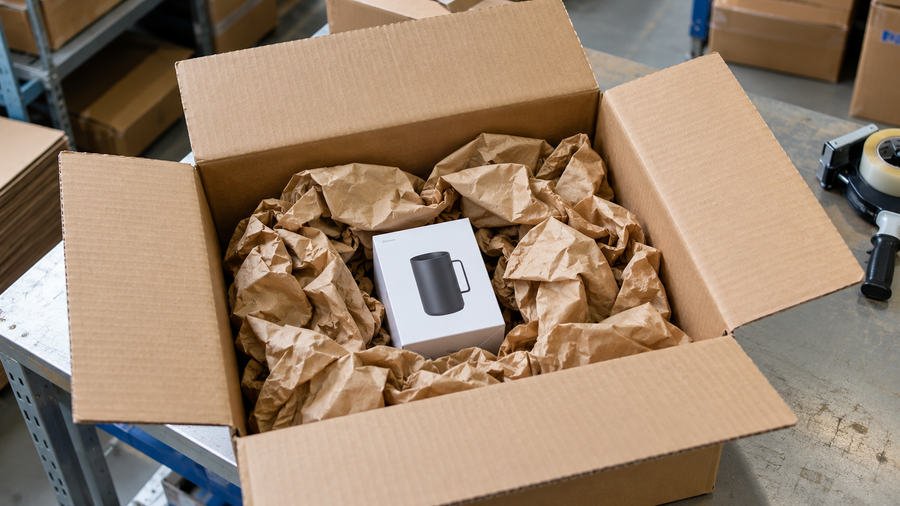
Think in layers: product, retail pack, cushioning, and outer shipping pack. Corrugated board, paper void fill, air pillows, molded pulp, foam corners and padded mailers all affect size and protection differently. A decorative gift box may look lovely and still push a small product into a much larger shipping carton. A flatter insert may do the same branding job with less cube.
When comparing two pack designs, record more than DIM:
| Packaging decision | Measure alongside billable weight |
|---|---|
| Smaller carton | Fit, crush protection, material price, pack time and returns |
| Mailer instead of box | Product deformation, puncture risk, branding and seal quality |
| Thinner cushioning | Breakage or leak rate from actual transit tests |
| Separate branded inner box | Outer cube, assembly labor and customer experience |
The full cost of a pack includes setup and materials as well as freight. Our guide to custom packaging costs in China helps map those other pieces. Do not chase a lower DIM figure by deleting the protection that keeps your product sellable.
Calculate a batch of ecommerce orders in a spreadsheet
One sample box is useful. A brand might ship 50 combinations of sizes, inserts and destinations. Give each actual packed parcel a row. Do not average the lengths of several boxes and calculate DIM once from that average; multiplication does not work that way.
A practical worksheet uses these columns:
| Column | Example content | Purpose |
|---|---|---|
| A: package ID | Order 1042, parcel 1 | Keeps split shipments separate |
| B–D: outside L/W/H | Whole-inch values after the chosen measurement rule | Defines this parcel’s cube |
| E: actual packed weight | 12 lb | Supplies the scale comparison |
| F: applicable divisor | 139 in³/lb | Records the service assumption |
| G: DIM eligible? | Yes/No, after applying that service’s rule | Prevents a false DIM charge |
| H: raw DIM | B2*C2*D2/F2 | Makes the formula auditable |
| I: rounded DIM | Rule-specific result | Captures the billable increment |
| J: estimated billable weight | Larger applicable rounded actual or DIM value | Feeds a separate shipping-rate quote |
In a sheet with positive numeric inputs in compatible units, a generic H2 formula is =B2*C2*D2/F2. For an applicable service that rounds DIM up to whole pounds, I2 can be =ROUNDUP(H2,0). If E2 already contains the actual weight in the same applicable billable increment, J2 can be =IF(G2="Yes",MAX(E2,I2),E2). Do not copy the last two formulas into a service with different weight increments or a different eligibility rule. Record the rule beside the sheet.
For mixed orders, run each physical package separately. Two boxes in one customer order may have two different measurements and weight bases. Add shipping charges from actual service quotes; simply adding the two billable weights will not magically produce a price. A 3PL can also change the pack-out after your spreadsheet was built. Ask which carton it actually used.
Why the carrier invoice may differ from your estimate
You measured the sample. The carrier billed something else. Before assuming a mistake, find out which inputs changed.
| What you see | Check first | Next action |
|---|---|---|
| Billed dimensions are larger | Bulging side, taped seam, changed box or carrier remeasurement | Compare photos or pack station record with carrier scan |
| DIM figure is unexpectedly high | Unit mix-up, divisor, dimension rounding | Check the service and rate agreement |
| DIM appears on a small parcel | Service-specific threshold and invoice fee code | Verify whether it is DIM or a separate adjustment |
| Bill is higher but weight matches | Zone, fuel, handling, residential or oversize charge | Audit each surcharge separately |
| One order has two shipping charges | Split into two physical parcels | Match each tracking ID to a box |
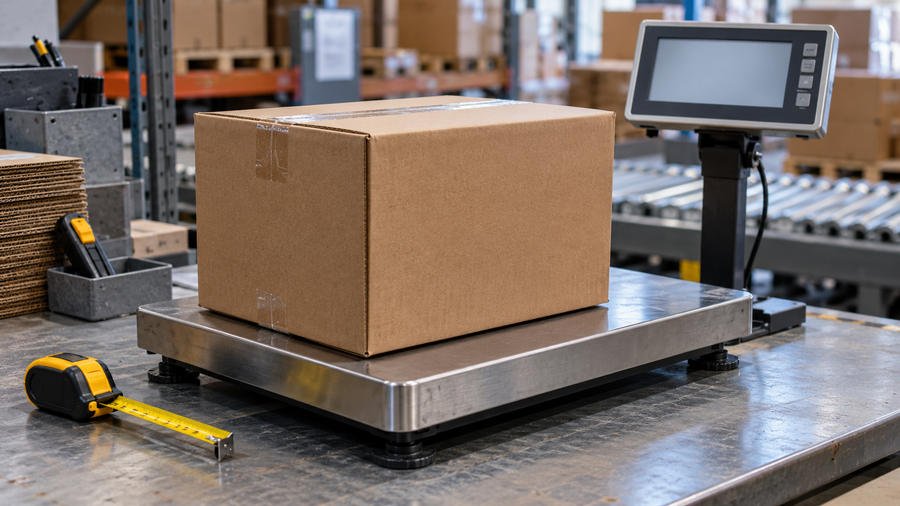
The carrier sees the sealed parcel handed over, not the product dimensions in your supplier’s catalog. An extra insert, a thicker foam sleeve or a box that balloons at the sides can move a dimension. Some services round measured dimensions before calculating the cube. That is why a photograph and the pack station’s measured L/W/H help during an invoice dispute.
Request the carrier’s billed dimensions, actual scanned weight, divisor or tariff basis, service name, tracking number and adjustment code. Compare them with the label purchase record and WMS pack record. If the same SKU suddenly moves from a 10-inch box to a 13-inch box, fix the packing instruction even if this one adjustment cannot be reversed. That is where the lasting saving lives.
And keep oversize separate. A parcel can have the expected DIM weight and still trigger an additional handling or large-package charge. The weight calculator is not a complete rate calculator.
Give your supplier, 3PL and store one version of the box
The product specification may say 32 × 23 × 8 cm. That is not necessarily the parcel size. Add a retail box, foam corners and an outer carton, and the finished dimensions change. Your store’s shipping settings, warehouse pack instruction and supplier packing list should not each describe a different package.
Make one finished pack sample for each common SKU or bundle. Measure its widest outside points and weigh it after the insert, label, tape and protective material are in place. Record the packaging version, not just the SKU. If the supplier switches cartons or a seasonal promotion adds a gift sleeve, remeasure. A small change near a carrier threshold can be more important than it looks.
The routine matters across categories. Apparel can often fold flatter, but some garments crease easily. Glass skincare needs impact and leak protection. Electronics may need antistatic or protective packing suited to the item. Subscription kits need the dimensions of the assembled kit parcel, not a sum of component dimensions. A large pillow may be compressible, but test whether it recovers and arrives presentable.
For China-based fulfillment, compare the available shipping services using the packed measurements, destination and product restrictions. FriendDropshipping’s shipping solutions page describes the route-selection context. The cost of shipping a bulk master carton to a warehouse is a different calculation from the billable weight of one consumer parcel. Air freight and ocean LCL can have their own measurement and charging rules. Keep each leg in its own row.
The site’s existing guide to why lightweight parcels can cost more explains the underlying idea in more depth. Here, the operational job is to preserve the measured finished pack and the rule used for this specific service so the estimate can be repeated next week.

After you find a costly box, make one controlled change
Pick a high-volume SKU whose billable weight is driven by size. Try one smaller carton or suitable mailer. Keep the actual product, destination mix and service comparable. Check fit and transit protection; then measure and weigh the sealed trial pack. Calculate its new billable weight with the same carrier rule. Get a fresh quote and watch breakage, returns and packing time after a pilot run.
If the trial works, update the warehouse’s carton selection rule and your store’s package data. Otherwise the spreadsheet will be right while the pack bench keeps using the old box. This is unglamorous work. It also beats paying to ship the same empty corner thousands of times.
Conclusion
A dimensional-weight calculation starts with a real, finished package. Measure it, weigh it, apply the correct service rule, and compare the two applicable weights. Then test packaging changes without dropping the protection your product needs. The result gives you an estimated billing weight, not a final postage price. Use the carrier quote for that. With the measurements and rule written down, a strange invoice becomes a question you can actually investigate.
FAQs
1. What numbers do I need for a dimensional weight calculator?
Outside length, width and height of the sealed parcel; its actual packed weight; and the applicable service’s divisor, threshold and rounding rule. Keep the units consistent.
2. Is dimensional weight the same as volumetric weight?
Usually, yes. Both describe a weight figure derived from parcel volume. “DIM weight” is common in U.S. parcel shipping. The service’s rules determine the billed result.
3. Do I measure the product or the sealed shipping box?
Measure the sealed outer package the carrier receives. Include any bulge or protection that changes its outside size. Product dimensions alone are too small for most shipping estimates.
4. Which is billed: actual weight or dimensional weight?
For many services, the greater applicable value is the billing basis. Eligibility thresholds and rounding can change the comparison, so check the exact service.
5. What does the DIM divisor mean?
It converts package volume into a weight figure. Its units might be in³/lb or cm³/kg. A smaller divisor produces a larger DIM weight for the same box.
6. Can I use 139 for every shipment?
No. It appears in some published U.S. carrier contexts, but rate types, services, destinations and contracts differ. Use the factor that applies to your shipment.
7. What is the 1,728 cubic inch threshold?
It equals one cubic foot. The cited USPS commercial Ground Advantage rule applies DIM to qualifying domestic parcels that exceed that volume. Other services may use different rules.
8. Does USPS apply DIM weight to all parcels?
No blanket rule should be inferred from one service. Confirm the product, zone, package shape and current USPS conditions before applying a threshold or divisor.
9. How do I calculate DIM weight in centimeters and kilograms?
Multiply outside L × W × H in centimeters, then divide by the service’s divisor expressed in cm³/kg. At 40 × 30 × 20 cm and 5,000 cm³/kg, raw DIM is 4.8 kg.
10. Do I round dimensions before or after calculating?
Follow the applicable carrier’s order of operations. For the cited USPS rule, round each dimension up to a whole inch before multiplying, then round an eligible DIM result up to a whole pound.
11. Why does my carrier’s billed weight differ from a calculator?
The carrier may have measured a different box size or weight, applied another divisor, or used a rule your tool omitted. Compare the billed scan and service with your pack record.
12. Does a lighter product always mean cheaper shipping?
No. A bulky, light product can be rated by its dimensional weight. Final price also depends on route, service and separate fees.
13. Can a poly mailer reduce DIM weight safely?
Sometimes, especially for flexible goods. Test puncture, crush, water and presentation risks. Fragile or leak-prone goods may need a box and cushioning.
14. How do I calculate DIM weight for multiple boxes in one order?
Measure and calculate each physical parcel separately under its own service rule, then obtain the carrier’s multi-package price. Do not average box dimensions.
15. Is billable weight the same as the final shipping price?
No. It is an input to rating the shipment. Carrier rate, destination, service, discounts and surcharges determine what you actually pay.
Table of Content

I’m Cassiel. I’ll help you scale your Shopify business with reliable fulfillment.
Join to newsletter.
Follow us and get more knowledge.

