
A circuit board can leave a warehouse looking perfect and arrive with a fault nobody can see. Perhaps someone pulled it from its protective bag on an ordinary packing bench, or let it brush against plastic film. It might pass an initial check and fail later. Electrostatic discharge, or ESD, does not always leave an obvious mark.
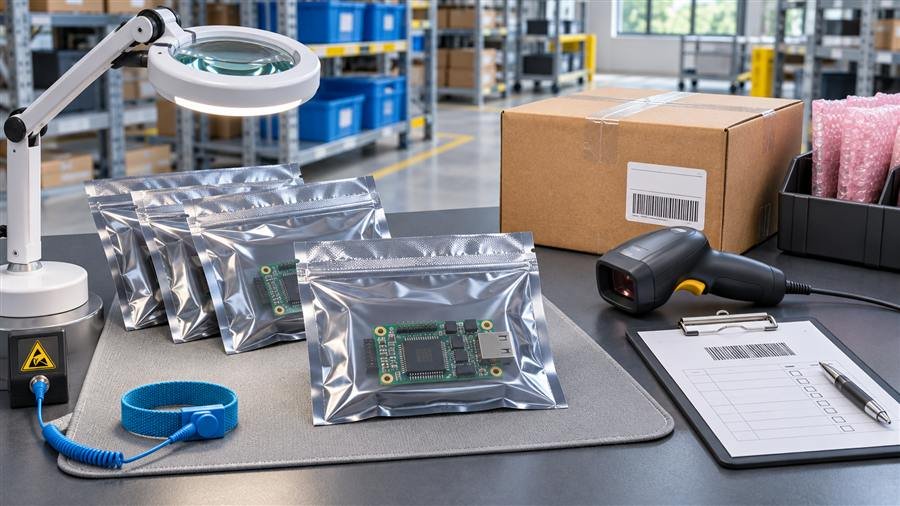
For an electronics brand, safe fulfillment means protecting a sensitive item through every handoff. The supplier’s bag, the storage bin, the pick cart, the inspection bench, and the shipping carton all matter. If a board travels unprotected across the warehouse, careful packing at the end comes too late.
Which electronics actually need ESD-safe fulfillment?
Start with the item, not the warehouse equipment. An exposed semiconductor, sensor, integrated circuit, circuit board assembly (PCBA), or plug-in module may be ESD-sensitive. So may an unfinished device or a repair part with exposed contacts. Sensitivity varies. Ask the manufacturer for the device or assembly’s handling specification and any relevant sensitivity classification. Do not guess from the price tag or how sturdy the board looks.
A fully enclosed, sealed consumer product is a different case. If nobody opens its qualified factory packaging, its internal components may never be exposed during normal pick and pack. It still needs good physical protection, inventory control, and any product-specific handling rules. It does not automatically need an exposed-component workstation merely because it contains electronics. If a return is opened for testing, though, the work changes. The operator may be handling a sensitive assembly again.
Consider the mix of products a warehouse might see. An IoT supplier sends bare sensor modules to installers. An industrial controls brand ships replacement boards. A medical-device supplier stores sealed units alongside repair subassemblies. Automotive sensors and robotics kits add still more variations. Each SKU needs its own handling decision.
Give each SKU a handling decision: keep sealed, open only in a defined ESD protected area, or follow a documented product-specific process. If the supplier has not provided enough information, hold the item and ask. A little uncertainty at receiving is cheaper than a lot of uncertainty after a return.
Follow the product from receiving to dispatch
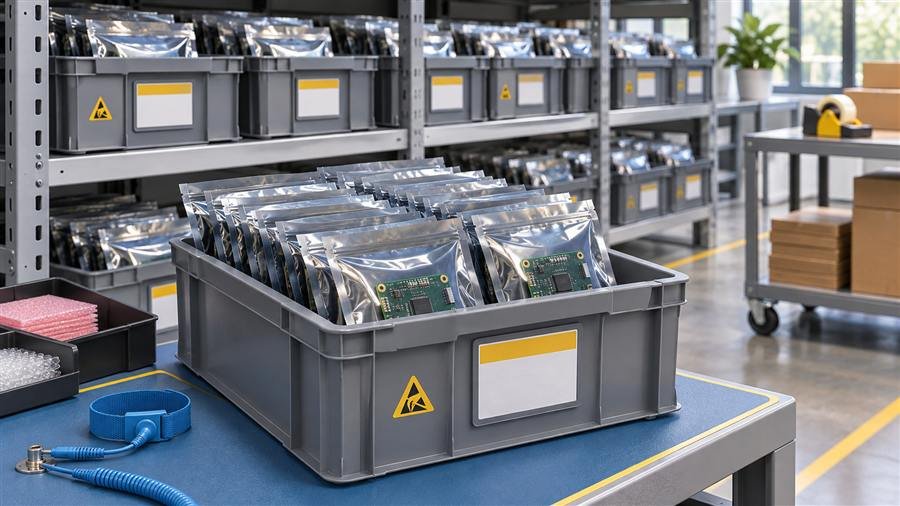
The chain cannot have a casual gap in the middle. An ESD-sensitive item should remain in suitable protective packaging whenever it is outside an ESD protected area (EPA). If someone opens it, the exposed handling belongs inside the defined controlled area.
| Handoff | Common slip | Control to specify | Useful record |
|---|---|---|---|
| Receiving | Torn or unsealed protective bag enters stock | Check pack condition and ESD marking; quarantine exceptions | Inbound inspection and photos |
| Put-away | Open components move into ordinary bins | Keep the approved enclosure intact; use defined locations | SKU and bin scan |
| Picking | A picker opens a bag to count parts | Count without exposure or move the task to an EPA | Pick and exception log |
| Inspection or kitting | Plastic trays or tools touch exposed boards | Use qualified handling materials and grounded personnel | Work instruction and test record |
| Packing | A low-charging bag is mistaken for a shielding shipper | Follow the SKU’s approved pack specification | Pack check and lot or serial record |
| Dispatch and returns | Protection is lost after the pack bench | Seal before leaving the EPA; route open returns for controlled inspection | Final verification and return disposition |
A sealed retail unit may skip several exposed-handling steps. A bare PCBA may need all of them. The warehousing inventory record should tell staff which path each SKU follows.
Storage controls: keep protection intact until a controlled handoff
Check the inbound package before shelving it
Receiving is the first chance to catch a bad handoff. Confirm the SKU, quantity, lot or serial information, and the supplier’s required pack type. Then inspect the protective package itself. Is the bag sealed as specified? Is it punctured, wet, or badly creased? Are labels legible? A carton can look fine while an inner bag has been opened and taped shut.
Put questionable stock on hold. Do not quietly swap in any bag marked “antistatic” and send it to a pick face. The replacement has to match the approved pack specification. Record what arrived, what was wrong, and who approved the next step. If inspection requires opening the package, do that in the appropriate EPA.
Choose locations and containers that fit the handling plan
An intact, qualified protective enclosure does much of the work during storage. Still, a warehouse needs clean locations, sensible handling, and a rule against opening bags on a random shelf. Store exposed parts only in the controlled containers and areas specified by the ESD program. Where a shelf, cart, or bin is part of an EPA, its material and grounding should be assessed as part of that setup. A green sticker on a plastic bin is not a test result.
Watch for small habits. Someone may pour loose connectors into a standard tote because it is faster to count them. Another person may set an open tray on a shipping carton during a stock check. These are the moments a written rule needs to cover. Mark the EPA boundary, train staff to recognize it, and give pickers a clear route for count discrepancies.
Keep other storage risks in their own lane
Moisture damage, corrosion, impact, and revision mix-ups need their own controls. Moisture-sensitive components may come with sealed packaging, a humidity indicator, desiccant, or floor-life instructions. Follow those instructions as well. An ESD shielding bag is only a moisture barrier if its specification says so; some packs are designed for both jobs.
The same goes for temperature and humidity in the room. Manage them when the product or process calls for it. Do not use a humidifier as a substitute for grounding, suitable work surfaces, and protective packaging. Keep revision, lot, and date information tied to the inventory location so a well-protected part is also the right part.
Handling controls: what happens when a bag is opened?
Set up the EPA around the work people actually do
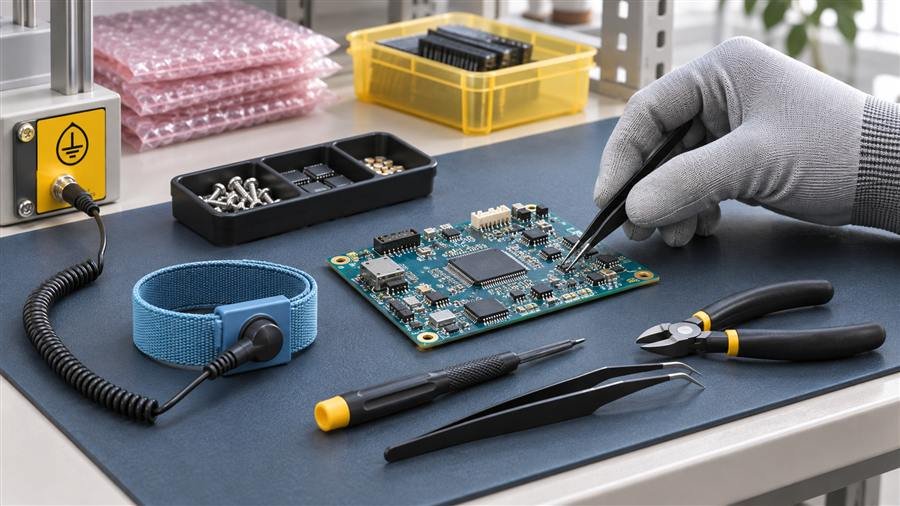
An EPA is a defined place where exposed ESD-sensitive items can be handled under an ESD control program. It can be a dedicated room or a properly equipped workstation. The EOS/ESD Association’s control guide describes the core ideas: identify sensitive items, define protected areas, bring conductors and personnel to a common potential, and use suitable work surfaces and handling materials.
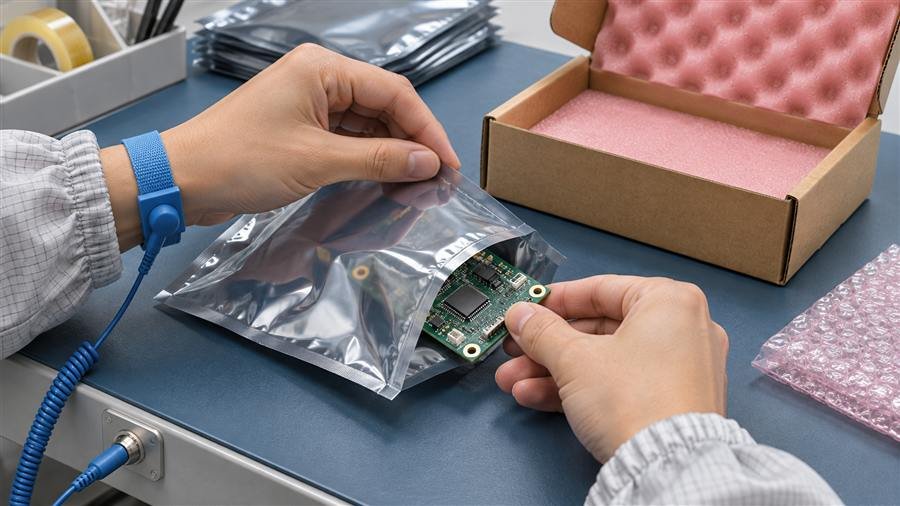
For a warehouse bench, that usually means a verified dissipative work surface connected to the correct grounding system, a way to ground the operator, and equipment and fixtures selected for the task. Seated operators commonly use wrist straps. Mobile work may use a tested footwear and floor system. The right choice depends on the process. A wrist strap lying on the table does nothing; it must be worn, connected, and checked under the site’s program.
Keep tape dispensers, ordinary plastic sleeves, foam, and other charge-generating materials away from exposed items unless the process has assessed them. Insulators cannot simply be grounded. If the job requires one, the ESD program may call for distance, a process change, or ionization. A fan over the bench is no substitute for that assessment.
Treat carts, trays, and tools as part of the path
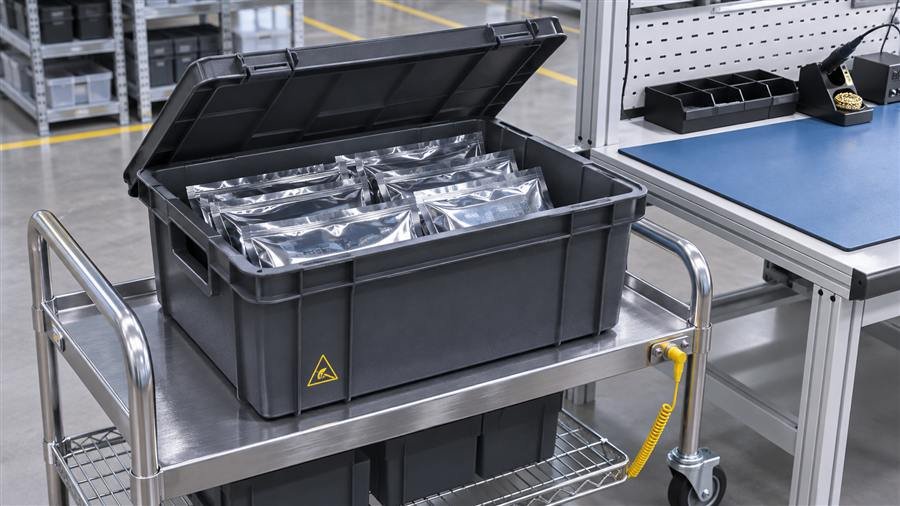
The product does not teleport from shelf to bench. Moving a cart or sliding a board in a tray can generate charge. Use approved trays, racks, and totes for exposed items. Check that a cart’s shelves and grounding method work together with the floor and the rest of the EPA. If a covered package is moving through an uncontrolled corridor, make sure the package is approved for that trip.
An inspection camera, scanner, caliper, or fixture may touch the assembly or sit near it. Include those tools in the work instruction. A bench can look tidy while a charged fixture sits beside the board.
Give pickers and returns staff a clear exception route
Suppose a picker finds a bag with a split seam. They should not peel it open to check whether the board looks okay. The item goes to a hold location, then to trained staff for controlled inspection and repacking. Record the bag condition, the part identity, and the decision. Visual inspection alone cannot rule out ESD damage.
Returns deserve the same care. A customer may send back a board wrapped in ordinary bubble film. Do not let it drift into saleable stock after a quick glance. Quarantine it, inspect and test as the product requires, and document whether it can be restocked, repaired, or rejected. A broader quality control workflow should keep those decisions traceable without implying that a simple visual check detects invisible electrical damage.
Packing controls: choose materials by the journey
People often say “ESD-safe bag” as if it were one material. It is not. The package needs to address charge generation, contact and discharge risk, and, when it leaves the EPA, exposure to uncontrolled handling. The exact solution depends on device sensitivity, contact points, package design, and destination.
| Material or property | What it helps with | What to check before use |
|---|---|---|
| Low-charging material | Reduces charge created by rubbing or separation | Whether it also gives the required shielding |
| Dissipative material | Lets charge drain in a controlled way when used correctly | Qualification, condition, and grounding where needed |
| Conductive material | Provides a low-resistance path; can be part of shielding | Direct-contact suitability and package design |
| Static shielding enclosure | Protects a sensitive item against discharge outside controlled areas | Size, closure, damage, and approved performance |
| ESD-qualified foam, tray, or bubble material | Cushions or separates items in a specified pack | Contact compatibility and whether an outer shield is still needed |
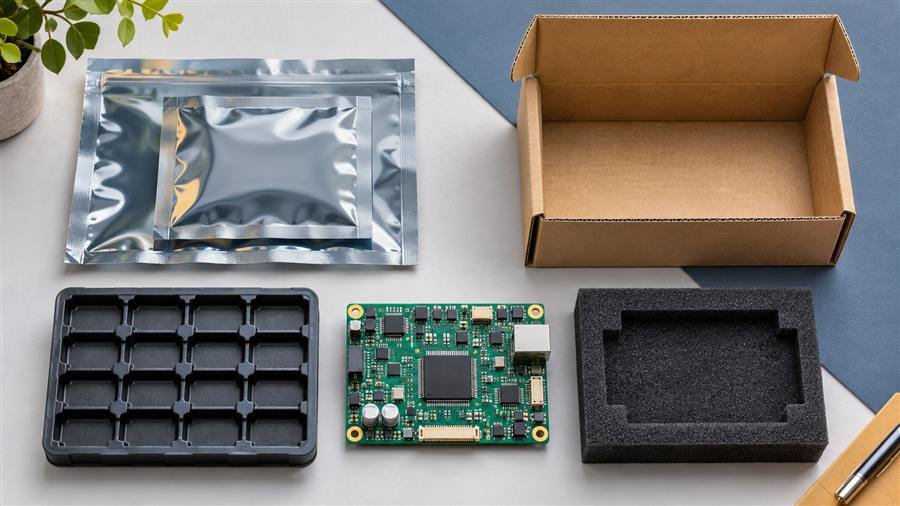
The familiar pink antistatic bag can mislead a hurried packer. It is typically low charging, but that label alone does not prove discharge shielding. A bare board shipped through a normal carrier network usually needs an approved shielding enclosure or another qualified packaging system that provides equivalent protection. Close a shielding bag as its specification requires; an open top weakens the enclosure.
Build the pack from the item outward. First, keep exposed contacts from rubbing against unsuitable material. Next, secure the part in the approved tray, foam, or inner support if the design calls for one. Add the protective enclosure required for movement outside the EPA. Then add cushioning and a sturdy outer carton for drops and vibration. ESD protection and impact protection solve different problems. A perfect shielding bag cannot stop a board from cracking in a loose box.
Plain cardboard may be acceptable as an outer box when the ESDS item is already properly enclosed. It should not be treated as the protective layer for an exposed board. Ordinary bubble wrap and packing peanuts also should not touch exposed sensitive assemblies unless the approved pack design specifically qualifies them. For branded unboxing, work backward from the protective inner pack; the custom packaging can still look good without compromising the technical layer.
At pack-out, confirm the SKU or serial, bag and cushioning type, seal, warning label where required, and final carton. Keep the approved bill of materials or pack instruction at the station. If a supplier changes a bag or foam, pause for a material review. “Looks about the same” is not an ESD property.
The standards and records a 3PL should be able to explain
Standards are useful when they turn a vague promise into a process someone can check. ANSI/ESD S20.20 addresses the ESD control program: identify sensitive items, define EPAs, establish grounding and personnel controls, qualify control items, and verify ongoing compliance. IEC 61340-5-1 is the related international framework for protecting electronic devices from electrostatic phenomena. They guide the program; they do not tell a packer which bag to grab for a particular SKU.
For packaging, see ANSI/ESD S541-2026. The EOS/ESD Association says it defines packaging properties for production, transport, and storage, and that IEC 61340-5-3 is technically equivalent. The useful warehouse question is whether the chosen packaging meets the needs inside and outside the EPA. An exposed item on a controlled bench and a sealed parcel on a carrier truck face different conditions.
Ask the 3PL to show the documents behind its claim: the ESD control plan, workstation and personnel test records, material qualification or supplier data, staff training records, SKU pack specifications, and logs for damaged bags or rejected stock. “We use ESD bags” tells you little about what happens between receiving and dispatch. A facility that references a standard may or may not hold a certification to it.
Numbers need context. A resistance value for a mat, a bag, or a footwear system is not interchangeable. The limits and test methods depend on the control item and applicable standard. Ask which test was used, when it was done, and what happens if the result fails. That answer tells you more than a neat-looking certificate with no link to the workbench.
A worked example: a bare PCBA order
Imagine a brand shipping replacement control boards to repair shops. The supplier sends each board in a sealed, approved shielding bag. At receiving, the warehouse checks the part number, revision, bag condition, and quantity. A torn bag goes on hold. Intact units go into a labeled storage location without anyone opening them to admire the boards.
An order comes in for one board and a cable. The picker scans the correct revision. If no inspection is needed, the board stays in its protective enclosure. If the pack instruction calls for a visual check or a cable kit, trained staff move it to an EPA, verify their grounding, open the bag there, complete the task, and close it in the approved protective pack before it leaves the area. The outer carton keeps the board from bending or bouncing around. The final scan ties the shipment to the right part and order.
If that order also includes a battery-powered device, review its battery classification and carrier rules. Moisture-sensitive parts may have separate storage instructions. The pack instruction has to account for each relevant risk.
Questions to ask an electronics fulfillment partner
When you evaluate a 3PL, ask staff to walk through the process using your SKU. Cover these points:
- Which items will remain sealed, and which tasks require an EPA?
- Where are the EPA boundaries for receiving, inspection, kitting, packing, and returns?
- How are personnel grounding, work surfaces, carts, and tools checked?
- What is the approved pack specification for each sensitive SKU?
- Does the pack protect the item when it leaves the EPA and enters a carrier network?
- Who approves replacement bags, trays, foam, or other substitutions?
- What happens to damaged inbound packs and poorly packed returns?
- Which scans, photos, test logs, or exception records can you retrieve later?
If the answers are specific, you can turn them into a receiving rule, pack instruction, and service agreement. If they are fuzzy, test the process with a small batch before scaling. When discussing a dropshipping fulfillment setup, share the actual part drawings, supplier packaging instructions, and destination list. Those details make it possible to assess the work rather than promise a capability in the abstract.
Conclusion
ESD-safe electronics fulfillment is a chain of ordinary decisions made consistently. Identify which products are sensitive. Keep the approved enclosure intact in storage and transit. Open exposed items only where people, surfaces, tools, and materials are controlled. Choose a packing system for the trip beyond the EPA, then record exceptions when reality gets messy.
A board needs protection even on the short trip to the next table.
FAQs
1. What does ESD-safe fulfillment mean in a warehouse?
It means a documented process for protecting ESD-sensitive items during receiving, storage, picking, inspection, packing, dispatch, and returns. The controls depend on the product and whether it is exposed or enclosed.
2. Does a sealed consumer device need an ESD-protected workstation?
Not automatically. If its qualified packaging stays closed and no sensitive parts are exposed, routine order handling may not call for an EPA. Testing, repair, or opening the device can change the requirement.
3. Are bare PCBs and assembled PCBAs handled the same way?
Do not assume so. Components fitted to a PCBA can introduce ESD sensitivity. Check the manufacturer’s instructions for each item and protect exposed assemblies according to the relevant process.
4. Is a pink antistatic bag enough for shipping?
Usually not for an exposed ESDS item moving through uncontrolled areas. “Antistatic” often means low charging. It does not, by itself, establish discharge shielding. Use the approved shipping pack for that item.
5. What is the difference between an antistatic bag and a shielding bag?
An antistatic or low-charging bag aims to reduce charge generation. A qualified shielding enclosure is designed to protect its contents from an external discharge. Check product data, not just the color.
6. Can regular bubble wrap touch an exposed board?
Avoid it unless the pack design explicitly qualifies that material for contact. Ordinary plastic can generate charge. Use suitable ESD protective contact materials and add physical cushioning outside the protective enclosure.
7. Can cardboard boxes be used for ESD-sensitive electronics?
Yes, often as an outer shipping carton around a properly protected item. Plain cardboard is not a substitute for the protective enclosure needed by an exposed sensitive assembly.
8. Do storage shelves and totes need to be grounded?
It depends on whether they are part of an EPA, what they touch, and how the process is designed. Evaluate and verify the materials and grounding path. An intact approved enclosure may let the item move through ordinary storage without exposing the part.
9. When should a product be opened inside an EPA?
When opening it exposes an ESD-sensitive item for inspection, counting, kitting, testing, or repacking. Define that step in the work instruction so staff are not deciding at the shelf.
10. Are wrist straps enough to make a packing station ESD-safe?
No. The work surface, grounding connection, nearby materials, equipment, training, and verification all matter. The strap also needs to be worn correctly and tested as the control plan requires.
11. Does higher warehouse humidity replace ESD controls?
No. Humidity can affect charge generation, but it does not replace an ESD control program. Follow the product’s environmental requirements and verify that the chosen controls work under the facility’s conditions.
12. How should a 3PL handle a bag that arrives torn or open?
Hold the stock, record the condition, and route it to trained staff. Any opening, inspection, or repacking of an exposed sensitive item should follow the controlled process. Do not assume visual appearance proves it is undamaged.
13. Can a shielding bag be reused?
Only if the approved process permits it and the bag still meets its closure and condition requirements. Tears, worn seams, or unreliable seals are reasons to replace it. Follow the pack supplier’s instructions.
14. Which ESD standards should I ask a fulfillment partner about?
Ask how its program uses ANSI/ESD S20.20 or IEC 61340-5-1, and how it selects packaging using ANSI/ESD S541 or IEC 61340-5-3. Then ask for the actual site procedures and records. A standard name alone does not prove compliance.
15. What records show that an ESD packing process was followed?
Look for approved pack instructions, staff training, grounding and workstation checks, material qualification, SKU or serial scans, and exception records. The right set depends on the product and your agreed service requirements.
Table of Content

I’m Cassiel. I’ll help you scale your Shopify business with reliable fulfillment.
Join to newsletter.
Follow us and get more knowledge.