Supplement dropshipping looks simple from the outside. Find a product, connect a store, send orders to a supplier, and let someone else ship. In real life, supplement brands deal with more moving parts than most ecommerce categories.
You need a reliable product source. You need labels that make sense. You need packaging that does not look cheap. You need batch numbers, expiry dates, and product documents. You need a shipping route that will not cause endless tracking complaints. If you sell gummies, powders, capsules, oils, or pet supplements, you also need to think about storage, heat, leakage, moisture, and customer trust.
That is why many sellers compare two common models:
-
Supplement dropshipping with a 3PL
-
Working with an end-to-end sourcing partner
Both can work. Both can save time compared with doing everything yourself. But they save time in different places, and they cost money in different ways.
A supplement 3PL usually helps with warehousing, inventory, pick-and-pack, shipping, tracking, and sometimes returns. An end-to-end sourcing partner can help with supplier search, samples, quality checks, packaging, storage, fulfillment, and shipping coordination. In other words, a 3PL is often stronger after the product is ready. A sourcing partner is often stronger before and during product setup.
For a supplement brand, the better model depends on your stage. If you already have a tested product and stable inventory, a 3PL may be efficient. If you are still sourcing, comparing factories, checking labels, building a private label product, or testing Shopify demand, an end-to-end partner may save more time and reduce expensive mistakes.
This guide compares both models in plain terms. It covers cost, speed, quality control, private label packaging, supplier communication, Shopify fulfillment, and scaling. It also explains when a hybrid model makes sense.
What Is Supplement Dropshipping with a 3PL?
Supplement dropshipping with a 3PL means you use a third-party logistics provider to store and ship supplement orders for your ecommerce business.
In most cases, you or your supplier sends inventory to the 3PL warehouse. When a customer places an order on Shopify, WooCommerce, Amazon, TikTok Shop, or another channel, the 3PL picks the product, packs it, creates a label, ships the parcel, and updates tracking.
A 3PL usually focuses on logistics. It may not help you choose a formula, negotiate with factories, inspect raw supplier documents, or create private label packaging. Some 3PLs offer value-added services, but their core job is still fulfillment.
Shopify explains 3PL as outsourcing ecommerce logistics such as warehousing, inventory management, picking, packing, and shipping to an outside provider.
What a Supplement 3PL Usually Handles
| Service | What It Means |
| Warehousing | Stores your supplement inventory |
| Pick and pack | Picks the correct SKU and packs each order |
| Shipping labels | Creates labels for domestic or international delivery |
| Tracking updates | Sends tracking numbers back to your store |
| Inventory sync | Shows available stock by SKU |
| Returns handling | Receives returns if supported |
| Kitting | Combines multiple SKUs into a bundle |
| Basic packaging | Uses standard mailers, boxes, or dunnage |
For simple products, this can be enough. For supplements, it depends on the 3PL’s experience with sensitive products.
What a Supplement 3PL May Not Handle
Many 3PLs do not handle:
-
Supplier sourcing
-
Formula comparison
-
COA collection
-
Ingredient review
-
Label wording review
-
Private label negotiation
-
Sample testing
-
Supplier audits
-
Packaging sourcing
-
Batch document checks
-
Product compliance support
That does not mean 3PLs are bad. It means you need to know where their role starts and ends.
What Is an End-to-End Sourcing Partner for Supplement Dropshipping?

An end-to-end sourcing partner helps with more than shipping. This type of partner supports the full product path from supplier search to customer delivery.
For supplement dropshipping, an end-to-end partner may help you find suppliers, compare quotes, order samples, check documentation, coordinate packaging, inspect goods, store inventory, fulfill orders, and choose shipping routes.
This model is closer to a private agent plus fulfillment partner. It is useful when you do not want to manage five separate vendors.
What an End-to-End Supplement Sourcing Partner Usually Handles
| Service | Why It Matters for Supplement Brands | End-to-End Partner Model |
| Supplier sourcing | Helps find suitable supplement manufacturers or suppliers | Included or supported |
| Sample coordination | Lets you test product, packaging, taste, texture, and delivery | Partner coordinates |
| Documentation checks | Helps collect COA, spec sheets, batch data, and expiry details | May include partner margin |
| Quality control | Checks product condition before storage or shipment | Often available |
| Custom packaging | Supports labels, bottles, pouches, inserts, and branded boxes | Usually coordinated |
| Inventory handling | Stores products and tracks stock | Warehouse or handling fee |
| Fulfillment | Ships customer orders | Fulfillment fee |
| Route comparison | Helps choose shipping methods by cost, speed, and risk | Route selected by partner |
| SKU management | Keeps packaging rules and product versions organized | Lower if partner checks earlier |
| Creating custom packaging | Low to medium | Lower |
This is why end-to-end sourcing partners are often better for early-stage private label supplement brands. They reduce the number of handoffs.
Supplement Dropshipping with 3PL vs End-to-End Sourcing Partner: Quick Comparison
| Factor | Supplement 3PL | End-to-End Sourcing Partner |
| Best for | Brands with ready inventory | Brands still sourcing or customizing products |
| Main strength | Warehousing and fulfillment | Sourcing, QC, packaging, and fulfillment coordination |
| Supplier support | Limited or none | Usually included |
| Product samples | Usually seller handles | Partner can help coordinate |
| Private label support | Sometimes | Usually stronger |
| Quality control | Basic warehouse checks | More flexible product and packaging checks |
| Cost visibility | Clear fulfillment fees | More bundled but needs quote clarity |
| Speed to launch | Fast if product is ready | Faster if you still need supplier setup |
| Best seller type | Established SKU owner | Shopify, DTC, private label, and dropshipping brands |
| Main risk | You manage sourcing alone | Depends on partner transparency |
Which Saves More Time for Supplement Dropshipping?
Time savings depend on what is slowing you down.
If your product is ready, your labels are approved, your supplier is reliable, and inventory is already produced, a 3PL can save a lot of time. You do not need to rent warehouse space, hire packers, buy shipping materials, or process every order by hand.
But if you are still trying to find the right supplement supplier, a 3PL will not solve the hardest part. You still need to compare manufacturers, collect documents, check samples, negotiate MOQ, review packaging, and manage production timelines.
That is where an end-to-end sourcing partner can save more time.
Time Savings with a Supplement 3PL
A supplement 3PL saves time mainly in daily operations.
| Task | Time Saved by 3PL |
| Receiving inventory | Medium |
| Storing products | High |
| Picking orders | High |
| Packing parcels | High |
| Creating shipping labels | High |
| Updating tracking | High |
| Handling returns | Medium |
| Finding suppliers | Low |
| Checking product documents | Low |
| Creating custom packaging | Low to medium |
A 3PL is efficient after your supply chain is already built.
Time Savings with an End-to-End Sourcing Partner
An end-to-end sourcing partner saves time across the full launch process.
| Task | Time Saved by End-to-End Partner |
| Finding supplement suppliers | High |
| Comparing quotes | High |
| Ordering samples | High |
| Checking packaging options | High |
| Collecting product documents | Medium to high |
| Coordinating production | Medium to high |
| Inspecting products | High |
| Managing fulfillment rules | High |
| Shipping orders | High |
| Scaling SKUs | Medium to high |
If you are new to supplement dropshipping, the second list is often more important.
Which Saves More Money for Supplement Dropshipping?

The cheaper model depends on your stage, order volume, product range, and how much control you already have over factories.
For most new supplement stores, an end-to-end sourcing partner usually saves more money in the early stage. This may sound strange, because a 3PL can look cheaper on paper. But early-stage sellers often lose money in places that do not show up on a simple fulfillment quote.
They lose time talking to different factories. They struggle to compare prices, MOQ, packaging, production time, and product quality. They may need one factory for capsules, another for gummies, another for bottles, another for labels, and another for custom boxes. Every extra supplier adds more communication, more follow-up, and more room for mistakes.
For a store doing fewer than 100 orders per day, this can become expensive fast. The seller may save a few cents on product cost by going directly to factories, but lose weeks on communication, sampling, packaging checks, and shipping coordination. Worse, they may miss the best selling window because the product launch takes too long.
An end-to-end sourcing partner can reduce that pressure. Instead of managing several factories by yourself, one partner helps coordinate sourcing, samples, quality control, packaging, storage, fulfillment, and shipping. This is especially useful when the store sells many supplement products or is not familiar with Chinese factories.
A 3PL can save more money later, but usually when the business is more stable. If you sell one product or only a few SKUs, already know the factory, trust the product quality, and have stable order volume above 100 orders per day, then direct factory purchasing plus 3PL fulfillment can lower product cost. At that stage, you can buy in bulk, control production better, and send inventory to a 3PL warehouse for pick and pack.
Cost Logic: End-to-End Partner vs 3PL by Store Stage
| Store Situation | Better Model | Why |
| New store with many supplement SKUs | End-to-end sourcing partner | Saves time on supplier search, packaging, QC, and fulfillment setup |
| Seller unfamiliar with Chinese factories | End-to-end sourcing partner | Reduces communication errors and supplier risk |
| Store under 100 orders per day | End-to-end sourcing partner | Time cost is usually higher than factory price savings |
| Store selling 1-3 stable products | 3PL may work better | Easier to control factory, inventory, and packaging |
| Store above 100 orders per day | 3PL or hybrid model | Bulk factory orders can reduce product cost |
| Seller has strong factory relationships | 3PL may save more | Product side is already under control |
| Store needs custom logos and packaging for many products | End-to-end sourcing partner | Avoids managing many packaging suppliers separately |
Example: A Store Selling 20 Orders Per Day
Imagine a Shopify supplement store sells 20 orders per day across 5 products: gummies, capsules, powders, pet supplements, and collagen sachets.
If the seller uses a 3PL only, they still need to handle:
-
Factory search for each product
-
Product samples
-
Label and packaging discussions
-
Logo printing
-
Bottle, pouch, and box suppliers
-
Factory delivery time
-
Quality checks before warehouse arrival
-
Stock coordination
-
Shipping route testing
Even if direct factory buying saves USD 0.30 per unit, the seller may spend dozens of hours managing suppliers. If one label is wrong or one factory ships late, the store may lose sales during the launch window.
For this type of store, an end-to-end partner can save more money by reducing management time, preventing packaging mistakes, and helping the seller launch faster.
Example: A Store Selling 100+ Orders Per Day
Now imagine a store sells 120 orders per day of one best-selling collagen powder.
The seller already knows the factory. The formula is stable. Packaging is approved. Product quality is predictable. The factory ships on time. The seller can order in bulk.
In this case, using a 3PL can make more sense. The seller can buy directly from the factory at a lower unit cost, send inventory to a 3PL warehouse, and let the 3PL handle daily fulfillment.
The savings come from bulk production and lower product cost, not from avoiding supplier communication. At this stage, the seller has enough volume to make direct factory management worthwhile.
Simple Money-Saving Comparison
| Example Store | Model | Main Saving | Possible Risk |
| 20 orders/day, 5 SKUs | End-to-end partner | Saves time, avoids supplier confusion, launches faster | Product unit cost may be slightly higher |
| 50 orders/day, mixed products | End-to-end partner or hybrid | Better coordination for sourcing, packaging, and QC | Need clear pricing from partner |
| 100+ orders/day, 1-3 stable SKUs | 3PL | Lower product cost through bulk factory orders | Seller must control factory quality and timing |
| 200+ orders/day, stable supply chain | 3PL or hybrid | Better warehouse efficiency and lower per-order cost | Inventory planning becomes important |
The real question is not “Which model has the lowest fee?” The better question is:
Do you already control the product side well enough to use a 3PL efficiently?
If the answer is no, an end-to-end sourcing partner may save more money.
If the answer is yes, a 3PL may help reduce fulfillment cost and support scale.
Real Cost Comparison: 3PL vs End-to-End Sourcing Partner
Here is a simplified example. The numbers are illustrative. Actual costs depend on product weight, destination, order volume, packaging, shipping route, and service level.
| Cost Area | 3PL Model | End-to-End Partner Model |
| Supplier search | Seller time or paid consultant | Included or supported |
| Sample coordination | Seller pays and manages | Partner coordinates |
| Product unit cost | May be lower if seller negotiates well | May include partner margin |
| QC before storage | Extra fee or not offered | Often available |
| Custom packaging | Separate vendor or 3PL add-on | Usually coordinated |
| Storage | Standard 3PL fee | Warehouse or handling fee |
| Pick and pack | Standard 3PL fee | Fulfillment fee |
| Shipping | Carrier/route cost | Route selected by partner |
| Mistake cost | Seller absorbs sourcing mistakes | Lower if partner checks earlier |
| Management time | Higher | Lower |
The main point is simple: a 3PL may save money if you already know how to source. An end-to-end partner may save money if it helps you avoid bad sourcing decisions.
Example Cost Comparison: How Much Money Can Each Model Save?
The main point is simple: a 3PL may save money if you already know how to source. An end-to-end partner may save money if it helps you avoid bad sourcing decisions.
Here is a practical way to look at the numbers.
For a new supplement store, the biggest cost is often not the fulfillment fee. It is the hidden cost of time, supplier mistakes, bad samples, wrong packaging, delayed production, and poor quality control.
For a stable supplement store, the biggest saving usually comes from bulk factory pricing and lower per-order fulfillment cost.
| Example Store | Better Model | Where the Saving Comes From | Estimated Annual Saving |
| New store, 20 orders/day, 5 SKUs | End-to-end partner | Less supplier communication, fewer sampling mistakes, better packaging coordination, fewer QC issues | USD 8,000-25,000/year |
| Growing store, 50 orders/day, mixed SKUs | End-to-end partner or hybrid | Faster launch, fewer supplier errors, less time spent managing factories, fewer refund risks | USD 15,000-45,000/year |
| Stable store, 100 orders/day, 1-3 SKUs | 3PL | Lower unit cost from bulk factory orders, better warehouse efficiency, lower per-order handling cost | USD 12,000-35,000/year |
| Scaled store, 200 orders/day, stable SKUs | 3PL or hybrid | Bulk purchasing, negotiated fulfillment fees, better inventory planning | USD 35,000-100,000+/year |
For example, a new Shopify supplement store selling 20 orders per day across five different products may need to talk with several suppliers. One factory may make gummies. Another may make capsules. Another may provide bottles. Another may print labels. Another may make custom boxes.
If the founder spends 10-15 hours per week managing sourcing, samples, packaging, factory follow-up, and shipping coordination, that time has a real cost.
| Hidden Cost Area | Conservative Estimate |
| Founder or operator time: 10 hours/week x USD 30/hour x 40 weeks | USD 12,000 |
| Wrong samples, repeated sample shipping, and product testing mistakes | USD 1,000-3,000 |
| Packaging rework from wrong label size, box size, or logo placement | USD 1,000-5,000 |
| Quality problems causing refunds, resends, or customer complaints | USD 2,000-8,000 |
| Missed launch window from slow factory communication | USD 3,000-10,000+ |
| Potential annual cost avoided by end-to-end partner | USD 19,000-38,000+ |
This does not mean the end-to-end partner makes every product cheaper. The unit cost may be slightly higher than going directly to every factory yourself. But for a new seller, the savings often come from avoiding confusion, delays, rework, and quality problems.
Now compare that with a stable seller doing 100 orders per day with one main product.
If the seller already knows the factory, trusts the quality, and can order in bulk, using a 3PL may reduce product and fulfillment costs.
| Saving Area with 3PL | Conservative Estimate |
| Bulk factory order saves USD 0.30 per unit x 36,500 orders/year | USD 10,950 |
| Better freight planning saves USD 0.15 per order x 36,500 orders/year | USD 5,475 |
| Lower pick-and-pack or warehouse efficiency saves USD 0.20 per order x 36,500 orders/year | USD 7,300 |
| Fewer stock handling mistakes from stable SKU rules | USD 2,000-5,000 |
| Potential annual saving from 3PL model | USD 25,725-28,725+ |
So the better model depends on where your money is leaking.
If your store is still losing time on suppliers, samples, packaging, and quality checks, an end-to-end partner may save more.
If your product is stable and your factory process is already under control, a 3PL can save more through bulk purchasing and fulfillment efficiency.
Why Supplements Are Different from Ordinary Dropshipping Products

Supplements are not like phone cases, keychains, or fashion accessories. Customers consume them. That changes the level of trust required.
Dietary supplements in the United States are subject to current good manufacturing practice rules. FDA explains that dietary supplement cGMP rules are designed to help ensure quality throughout manufacturing, packaging, labeling, and holding. According to FDA inspections, CGMP regulations generally address matters including appropriate personal hygienic practices, design and construction of a food plant and maintenance of plant grounds, plant equipment, sanitary operations, facility sanitation, and production and process controls during the production of food.
Even if you are not selling only in the U.S., the principle still matters. Supplement brands need a more careful supply chain.
Supplement Dropshipping Risks That Cost Time and Money
| Risk | What It Can Cost |
| Missing COA | Delays, buyer distrust, platform issues |
| Wrong label | Reprint cost and compliance risk |
| Poor packaging | Refunds and bad reviews |
| Unstable gummies | Melting, deformation, complaints |
| Moisture in powders | Clumping and product waste |
| Expired stock | Refunds and brand damage |
| No batch tracking | Harder to investigate complaints |
| Bad shipping route | Long delays and chargebacks |
| Supplier changes formula | Product page becomes inaccurate |
This is why a supplement fulfillment model should include quality checks and document discipline, not only shipping.
When a Supplement 3PL Is the Better Choice
A 3PL can be the better choice when your business is already organized.
Use a supplement 3PL if:
-
You already have a trusted supplier.
-
Your product formula is stable.
-
Your labels and packaging are ready.
-
You already own inventory.
-
You need faster pick-and-pack.
-
You want a warehouse closer to customers.
-
You have predictable order volume.
-
You can manage supplier communication yourself.
-
You have enough margin to hold inventory.
Best Use Case: Established Supplement SKU
For example, a Shopify brand already selling a collagen powder may have a tested formula, finished packaging, stable reviews, and 1,000 units ready for storage. In this case, a 3PL can help the brand ship faster and reduce daily workload.
The 3PL does not need to help choose the formula. It only needs to receive inventory, store it correctly, ship accurately, and update tracking.
When an End-to-End Sourcing Partner Is the Better Choice

An end-to-end sourcing partner is often better when you are still building the product and supply chain.
Use an end-to-end sourcing partner if:
-
You do not have a trusted supplier yet.
-
You need help comparing product options.
-
You want to launch private label supplements.
-
You need custom packaging or inserts.
-
You want samples before committing to inventory.
-
You sell through Shopify and need flexible fulfillment.
-
You need quality control before shipping.
-
You want one partner to manage sourcing and fulfillment.
-
You are testing multiple supplement products.
Best Use Case: Shopify Supplement Dropshipping Brand
Imagine a new Shopify brand wants to sell probiotic capsules, sleep gummies, and pet joint chews. The founder does not know which supplier is reliable. They also need custom labels, samples, and shipping tests.
In that case, a standard 3PL is too late in the process. The seller first needs sourcing, product comparison, sample checks, packaging coordination, and a fulfillment plan.
An end-to-end sourcing partner can save weeks of back-and-forth.
Supplement 3PL vs End-to-End Partner for Private Label Brands
Private label supplement brands need more support than generic dropshipping stores. The product carries your brand name. If the product is bad, customers blame you.
Private Label Support Comparison
| Need | 3PL | End-to-End Partner |
| Supplier search | Usually no | Yes |
| Label printing | Sometimes | Yes |
| Bottle or pouch sourcing | Sometimes | Yes |
| Insert cards | Sometimes | Yes |
| MOQ negotiation | No | Often yes |
| Sample checks | No or limited | Yes |
| Packaging inspection | Basic or add-on | Stronger |
| Branded unboxing | Sometimes | Usually easier |
For private label work, FriendDropshipping’s Customization & Private Pack service is a relevant internal resource because packaging is often where generic dropshipping becomes a real brand.
Supplement 3PL vs End-to-End Partner for Shopify Sellers
Shopify sellers usually care about speed, tracking, margin, branding, and repeat purchase. They also need flexibility because early products can change quickly.
Shopify Supplement Dropshipping with a 3PL
A 3PL works well if your Shopify store already has proven products. You can sync orders, ship from inventory, and track fulfillment status.
But if you are still testing offers, a 3PL can feel rigid. You may need to buy inventory first. You may also pay storage fees before knowing whether the product sells.
Shopify Supplement Dropshipping with an End-to-End Partner
An end-to-end partner can be more flexible in the testing stage. You can test products, compare suppliers, adjust packaging, and create a better fulfillment process before committing to larger inventory.
This does not mean you should avoid inventory forever. It means you should avoid buying the wrong inventory too early.
Supplement Dropshipping with 3PL vs End-to-End Partner for Quality Control

Quality control is where many supplement dropshipping plans break.
A warehouse worker can check whether a bottle is broken. But they may not know whether the product label matches the correct formula, whether the expiry date is acceptable, or whether the supplier changed the capsule count.
QC Tasks That Matter for Supplement Brands
| QC Task | Why It Matters |
| Count check | Confirms bottle count, capsule count, or unit quantity |
| Label check | Confirms SKU, dosage, claims, and barcode |
| Expiry check | Prevents expired or near-expired stock from shipping |
| Batch check | Helps trace products if a complaint happens |
| Packaging check | Prevents damaged or poor-looking orders |
| Leak check | Important for oils and liquids |
| Heat sensitivity check | Important for gummies and softgels |
| Document check | Confirms COA or product files are available |
FriendDropshipping’s Quality Control service fits this part of the workflow. It is especially useful when the product needs more than basic warehouse receiving.
Supplement Dropshipping Cost: Where Sellers Usually Overspend
Many supplement sellers do not overspend on fulfillment. They overspend on mistakes.
Common expensive mistakes include:
-
Ordering too much inventory before testing demand
-
Choosing the cheapest supplier without documents
-
Reprinting labels because claims were too aggressive
-
Paying for slow shipping that creates chargebacks
-
Buying packaging that does not fit the product
-
Using a general 3PL that does not track expiry dates
-
Launching too many SKUs too early
-
Ignoring product samples
Hidden Cost Table
| Hidden Cost | How It Happens | Better Approach |
| Bad sample | Seller skips sample testing | Test sample before launch |
| Wrong supplier | Seller chooses lowest price | Compare documents and communication |
| Packaging mismatch | Bottle or box does not fit | Confirm dimensions before production |
| Slow route | Cheapest route chosen blindly | Test shipping route first |
| Expired inventory | No expiry tracking | Use FEFO or expiry-aware fulfillment |
| Support overload | Customers ask about tracking | Use reliable tracking updates |
| Low repeat purchase | Product looks generic | Improve packaging and instructions |
End-to-end partners can save money when they reduce these mistakes.
Does a 3PL or End-to-End Partner Save More Time in the First 90 Days?

For a new supplement dropshipping business, the first 90 days are usually not about warehouse efficiency. They are about validation.
You need to answer:
-
Which product should we sell?
-
Is the supplier reliable?
-
Can customers understand the offer?
-
Does the product arrive in good condition?
-
Is the shipping time acceptable?
-
Can we make a margin after ads and refunds?
-
Can we reorder without chaos?
First 90 Days Comparison
| Task | 3PL Model | End-to-End Partner Model |
| Find supplier | Seller handles | Partner supports |
| Order samples | Seller handles | Partner supports |
| Check packaging | Seller handles | Partner supports |
| Test shipping | Seller coordinates | Partner coordinates |
| Store setup | Seller handles | Seller handles |
| Fulfillment setup | 3PL handles after inventory arrives | Partner can handle earlier |
| QC process | Add-on or limited | Built into workflow |
| Launch speed | Fast only if inventory ready | Faster if sourcing is needed |
For most early-stage supplement sellers, the end-to-end model saves more time in the first 90 days.
Does a 3PL or End-to-End Partner Save More Money After Scaling?
After scaling, the answer can change.
If you sell hundreds or thousands of orders per month, a specialized 3PL can become cheaper per order. You may negotiate better storage, pick fees, and shipping rates. You may also move best-selling SKUs into a warehouse closer to your main customers.
But an end-to-end partner can still be useful for:
-
New product sourcing
-
Supplier backup
-
Packaging upgrades
-
QC before stock transfer
-
China-side consolidation
-
Custom bundles
-
New market tests
Scaling Stage Comparison
| Stage | Better Model |
| Product research | End-to-end sourcing partner |
| Sample testing | End-to-end sourcing partner |
| First launch | End-to-end sourcing partner |
| Stable SKU with inventory | 3PL or hybrid |
| High volume local delivery | 3PL or local warehouse |
| New product expansion | End-to-end sourcing partner |
| Private label upgrade | End-to-end sourcing partner |
| Multi-country fulfillment | Hybrid model |
The most efficient brands often use a hybrid model.
Hybrid Model: 3PL Plus End-to-End Sourcing Partner

You do not always need to choose one forever.
A smart model can look like this:
-
Use an end-to-end partner to source, sample, inspect, package, and test products.
-
Fulfill early orders through the partner or China warehouse.
-
Identify best-selling SKUs.
-
Send proven inventory to a 3PL closer to your main market.
-
Keep using the sourcing partner for new products, QC, and China-side packaging.
This reduces risk. You avoid sending unproven products to a warehouse too early, but you can still use 3PL efficiency once volume grows.
Decision Framework: Which Model Should You Choose?
Use this table as a simple decision guide.
| Your Situation | Recommended Model |
| You already own finished supplement inventory | 3PL |
| You need help finding a supplier | End-to-end sourcing partner |
| You want private label packaging | End-to-end sourcing partner |
| You need fast local delivery for a proven SKU | 3PL |
| You are testing Shopify supplement products | End-to-end sourcing partner |
| You sell regulated or sensitive supplement formats | End-to-end or specialized 3PL |
| You want lowest per-order cost at high volume | 3PL or hybrid |
| You want fewer vendors to manage | End-to-end sourcing partner |
| You plan to launch multiple new SKUs | End-to-end sourcing partner |
| You already have operations staff | 3PL may be enough |
How FriendDropshipping Combines Both Models
FriendDropshipping sits between a traditional 3PL and an end-to-end sourcing partner.
A normal 3PL usually starts working after your product is ready. You send inventory to the warehouse, and the 3PL handles storage, pick and pack, shipping, and tracking.
FriendDropshipping can support that, but it can also help earlier in the process. This is useful for supplement sellers who are still choosing products, comparing factories, testing packaging, or building a private label brand.
What FriendDropshipping Can Help With Before Fulfillment
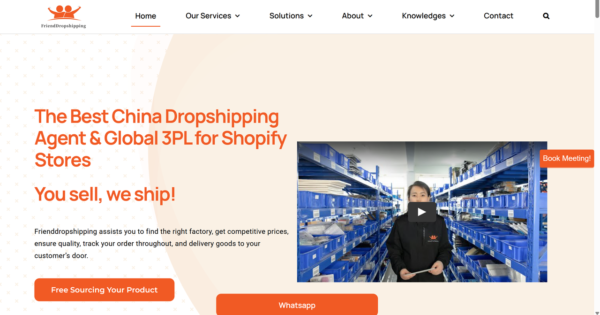
FriendDropshipping can help sellers coordinate:
-
Supplement product sourcing
-
Supplier comparison
-
Sample orders
-
Factory communication
-
Custom logo packaging
-
Labels, boxes, bottles, pouches, and inserts
-
Quality control before shipment
-
Batch and expiry checks where needed
-
China warehouse storage
-
Shopify order fulfillment
-
International shipping routes
This makes it useful for early-stage stores that do not want to manage every factory and packaging supplier alone.
For example, if a seller wants to launch capsules, gummies, and pet supplements at the same time, the work can quickly become messy. Each product may need a different factory, different packaging, different label size, and different production timeline. FriendDropshipping can help connect those steps so the seller does not lose weeks going back and forth with separate suppliers.
When FriendDropshipping Works Like an End-to-End Partner
FriendDropshipping is useful as an end-to-end partner when:
| Situation | How FriendDropshipping Helps |
| You are new to supplement dropshipping | Helps with sourcing, samples, packaging, and fulfillment setup |
| You sell several supplement products | Coordinates different suppliers and product types |
| You need custom logo packaging | Helps manage labels, boxes, inserts, and packaging checks |
| You are not familiar with Chinese factories | Reduces communication and supplier management pressure |
| You need quality control | Checks product and packaging before orders ship |
| You want to launch faster | Reduces the time spent coordinating multiple vendors |
This model is usually better for sellers under 100 orders per day, especially if they sell multiple products or are still testing the market.
When FriendDropshipping Works Like a 3PL
FriendDropshipping can also support a more traditional 3PL-style workflow.
If you already have a stable supplier, approved packaging, and steady sales, you can use FriendDropshipping for storage, pick and pack, order fulfillment, and shipping.
This works better when:
| Situation | How FriendDropshipping Helps |
| You already have stable products | Stores and fulfills orders |
| You sell 100+ orders per day | Supports daily order processing |
| You want China-based fulfillment | Keeps stock close to factories |
| You use custom packaging | Packs orders according to brand rules |
| You need shipping support | Helps compare shipping routes |
| You want fewer fulfillment mistakes | Uses clearer SKU and packing rules |
In this stage, the seller may buy directly from the factory to reduce product cost, then use FriendDropshipping to handle warehouse and shipping work.
Best Recommendation
For new supplement stores, FriendDropshipping is best used as an end-to-end sourcing and fulfillment partner.
For stable stores, it can work more like a 3PL.
For growing brands, the best setup is often hybrid:
-
Use FriendDropshipping to source and test products.
-
Build custom packaging after the product is validated.
-
Use quality control before stock enters fulfillment.
-
Fulfill early orders from China.
-
Move proven SKUs into a more stable warehouse workflow.
-
Keep using FriendDropshipping for new product sourcing and packaging updates.
This approach helps sellers avoid the two biggest mistakes in supplement dropshipping: launching too slowly and scaling with poor product control.
Questions to Ask a Supplement 3PL Before Signing
Before choosing a 3PL, ask:
-
Do you handle dietary supplements?
-
Can you track expiry dates?
-
Can you track batch or lot numbers?
-
Do you use FIFO or FEFO?
-
Can you handle gummies, powders, oils, and capsules?
-
Can you support custom packaging?
-
Do you offer kitting and bundles?
-
What are your storage fees?
-
What are your pick-and-pack fees?
-
How are lost or damaged orders handled?
-
Can you integrate with Shopify?
-
Can you ship internationally?
If the 3PL cannot answer supplement-specific questions, be careful.
Questions to Ask an End-to-End Supplement Sourcing Partner
Before choosing an end-to-end partner, ask:
-
How do you find supplement suppliers?
-
Can you help order samples?
-
Can you collect COA and product documents?
-
Can you inspect packaging before shipment?
-
Can you support private label bottles, pouches, or cartons?
-
Can you store inventory?
-
Can you fulfill Shopify orders?
-
Which shipping routes do you recommend?
-
How do you handle refunds or resends?
-
How transparent is your pricing?
-
Can you scale from test orders to bulk inventory?
A good partner should explain the process clearly. If everything sounds vague, slow down.
Final Verdict: Which Saves More Time and Money?
For a supplement brand with a finished product, stable inventory, and predictable sales, a 3PL can save time and reduce per-order work. It is a strong model when the product is ready and the main problem is fulfillment.
For a new or growing supplement dropshipping brand, an end-to-end sourcing partner often saves more time and money. It helps before fulfillment begins. That is where many costly mistakes happen: supplier choice, sample testing, packaging, product checks, and shipping route setup.
The simplest answer is:
-
Choose a 3PL if you already have the product and need warehouse efficiency.
-
Choose an end-to-end sourcing partner if you still need sourcing, QC, packaging, and launch support.
-
Choose a hybrid model when you have proven SKUs and want to scale without losing sourcing control.
Supplement dropshipping is not won by the cheapest shipping price. It is won by a supply chain that protects product quality, customer trust, and margin at the same time.
If your brand needs sourcing, supplement storage, private label packaging, quality control, and global fulfillment in one workflow, FriendDropshipping can help you compare the right model through Sourcing & Fulfillment, Supplement Fulfillment, 3PL Fulfillment Service, and Shipping Solutions.
FAQs About Supplement Dropshipping with 3PL vs End-to-End Sourcing Partner
Is a 3PL better than an end-to-end sourcing partner for supplement dropshipping?
A 3PL is better if your product is ready and you mainly need storage and fulfillment. An end-to-end sourcing partner is better if you need help with suppliers, samples, QC, packaging, and launch setup.
What is the main difference between a supplement 3PL and a sourcing partner?
A supplement 3PL focuses on warehousing, pick-and-pack, shipping, and tracking. A sourcing partner helps earlier in the process with supplier search, sample coordination, product checks, packaging, and fulfillment planning.
Which model saves more money for new supplement brands?
For new brands, an end-to-end sourcing partner can often save more money by preventing supplier mistakes, packaging errors, and poor shipping choices. For established brands, a 3PL may lower fulfillment cost per order.
Can a 3PL handle private label supplements?
Some 3PLs can store and ship private label supplements, and some can add inserts or simple packaging. But most 3PLs do not help create the private label product or source packaging from the beginning.
Is dietary supplement dropshipping risky?
It can be risky if you use weak suppliers, skip samples, ignore labels, or use fulfillment that does not track expiry dates. The risk is lower when you use quality checks, batch tracking, and reliable shipping routes.
Do supplement dropshipping brands need quality control?
Yes. Quality control is important for supplement brands because customers care about safety, packaging, expiry dates, label accuracy, and product condition.
Is a hybrid model better for scaling supplement brands?
Often, yes. A hybrid model lets you use an end-to-end partner for sourcing and product setup, then move proven inventory to a 3PL or local warehouse for faster delivery.
What should Shopify supplement sellers choose first?
Most early Shopify supplement sellers should start with an end-to-end sourcing partner if they still need supplier help, packaging, samples, or product checks. A 3PL becomes more useful once sales volume is stable.
Can FriendDropshipping help with both sourcing and supplement fulfillment?
Yes. FriendDropshipping supports supplement sourcing, quality control, private label packaging, storage, fulfillment, and shipping for ecommerce and dropshipping brands.
Is an end-to-end sourcing partner better for new supplement stores?
Yes, in most cases. New stores often need help with supplier search, samples, custom packaging, quality control, and shipping setup. Managing all of that alone can take too much time, especially if the seller is not familiar with Chinese factories.
When should a supplement seller choose a 3PL instead?
A 3PL is better when the seller already has stable products, reliable factories, approved packaging, and consistent order volume. It is especially useful when the store sells one product or only a few SKUs and receives more than 100 orders per day.
Why is direct factory sourcing not always cheaper for beginners?
Direct factory sourcing may reduce product cost, but beginners often spend too much time managing suppliers, packaging factories, samples, production delays, and quality checks. If mistakes delay the launch or cause customer complaints, the “cheap” option becomes expensive.
What model is best for a store selling many supplement products?
An end-to-end sourcing partner is usually better for stores selling many supplement products. Different products may require different factories, labels, bottles, pouches, boxes, and shipping rules. One partner can help coordinate everything more clearly.
Can FriendDropshipping support both sourcing and 3PL fulfillment?
Yes. FriendDropshipping can help with sourcing, custom packaging, quality control, storage, order fulfillment, and shipping. New sellers can use it as an end-to-end partner, while more stable sellers can use it more like a 3PL fulfillment partner.
Table of Content

I’m Cassiel. I’ll help you scale your Shopify business with reliable fulfillment.
Join to newsletter.
Follow us and get more knowledge.