1688 can feel like a huge wholesale market where the prices look good, but the signs, payment counter, and loading dock were designed for local buyers. That is why overseas businesses often use a 1688 sourcing agent.

The agent may search, buy, receive, inspect, consolidate, and arrange export shipping. Still, “we handle everything” is a sales sentence, not a process. You should know who owns each task, what evidence you will receive, and when your approval is required. This guide follows those handoffs from product brief to export-ready cartons.
What 1688 Is—and What a Sourcing Agent Actually Changes
Alibaba Group describes 1688 as China’s leading integrated domestic wholesale marketplace. It brings together wholesale suppliers across many industries and primarily serves the Chinese market.
Its domestic focus creates predictable friction: Chinese product pages and communication, local payment expectations, delivery to a China address, and limited export support. It is also a marketplace, not one factory. Listings may come from manufacturers, traders, wholesalers, or resellers. Neither a low price nor a badge proves production capability.
A sourcing agent adds a local operating layer between you and those sellers. The exact layer depends on the service you buy.
| Service role | Typical work | What the buyer should confirm |
| Buying or shopping agent | Places an order from links, pays the seller, and receives goods | Whether supplier search, negotiation, inspection, returns, and export are included |
| Full sourcing agent | Builds a shortlist, compares quotes, arranges samples, coordinates orders, and manages suppliers | How suppliers are verified, how fees are earned, and whether original quotes are visible |
| Consolidation warehouse | Receives parcels, stores them, combines orders, and repacks cartons | Counting scope, storage period, photos, SKU controls, and handling charges |
| Freight forwarder | Books transport and may coordinate export or import clearance | Route, chargeable weight, insurance, customs scope, exclusions, and delivery point |
| Fulfillment partner | Stores inventory and ships individual ecommerce orders | Receiving standard, inventory accuracy, processing cutoff, packaging, tracking, and claims policy |
One company may perform several roles, but each job still needs a defined scope. “Free inspection” might mean arrival photos and a color-label check, not a full count or functional test. “Shipping included” may exclude duties or destination charges. Buy a defined scope, not a comforting label.
Can You Buy From 1688 Without an Agent?
Sometimes, yes.
Direct buying can work if you can manage the account, Chinese communication, payment, domestic shipments, a China warehouse, defects, export, and destination imports. Otherwise, use a buying agent with your own forwarder or one integrated sourcing and fulfillment partner. Several suppliers, many SKUs, private-label details, and costly product failures make local support more valuable. Choose by control, complexity, risk, and total cost.

Decide Whether 1688 Fits the Order Before Chasing the Lowest Price
1688 is strong for discovery, ready goods, components, packaging, and mixed-SKU wholesale. Private label can work with proper control. Complex OEM products may need engineering, tooling, staged samples, and a factory built for custom work.
| Order type | 1688 fit | Likely agent need | Main risk |
| Ready-stock test order | Often good | Buying, receiving, and basic checking | Listing variation or wrong SKU |
| Mixed-SKU wholesale order | Strong | Purchasing, inbound mapping, consolidation, and export | Missing units and order mix-ups |
| Simple private label | Conditional | Sample approval, logo control, packaging, and inspection | Branding errors and hidden MOQ |
| New OEM product | Often limited | Deeper product development and factory management | Specifications, tooling, IP, and compliance |
| One-by-one overseas dropshipping | Usually awkward without support | Inventory or order-sync fulfillment | Processing time, tracking, and returns |
| Amazon FBA replenishment | Good when controlled | Inspection, labels, carton data, prep, and freight | Inbound noncompliance and inventory delays |
Do not compare platforms by unit price alone. Add domestic delivery, payment, agent work, inspection, repacking, freight, duty, and tax.
The useful number is landed cost per sellable unit:
Product and setup costs + China-side handling + international logistics + import costs + expected defect loss, divided by the number of sellable units received.
If you need an international-facing platform, clearer export communication, or a supplier willing to ship individual orders, the Alibaba dropshipping guide explains a different sourcing route. It is an alternative, not a rule that Alibaba is always better.

Start With a Brief the Agent Can Actually Buy Against
A 1688 link is a clue. It is not a complete product brief.
Sellers reuse images. One listing can contain several grades, sizes, or bundles. The first price shown may apply to the smallest part, the plain version, or a large quantity tier. If you send only a screenshot and say “I want this,” the agent has to guess. Guessing is where the order starts leaning sideways.
A usable brief should include:
-
product use and destination market;
-
material, grade, finish, dimensions, and weight;
-
color target and acceptable variation;
-
each SKU, size, color, and quantity;
-
required functions, parts, and accessories;
-
logo position, method, size, and color;
-
retail packaging and export-carton needs;
-
target cost and acceptable trade-offs;
-
sample requirements;
-
delivery deadline and final destination;
-
test reports, labels, warnings, or compliance evidence required for the destination.
For a silicone pet bowl, define the grade, capacity, wall thickness, weight, color, logo, package, and any food-contact requirements. For a tote, define fabric weight, fiber, size, handles, print, stitching, and packing. Without measurable details, three quotes may describe three different products.
Ask the agent to place unknown fields in an assumptions column. Do not let assumptions disappear inside a total price. You can approve them, change them, or ask suppliers for alternatives.
For a structured comparison rather than link-only ordering, a China product sourcing service can coordinate the brief, quotes, samples, and supplier questions before a bulk commitment.

How the Agent Should Search, Shortlist, and Verify 1688 Suppliers
Search Beyond the English Product Name
A capable agent can search with Chinese product terms, materials, manufacturing processes, product uses, and industrial locations. Image search is useful for finding visually similar items, but it has a weakness: sellers can copy the same photo.
The same bottle photo can hide different steel grades, wall thicknesses, or supplier roles. Ask the agent to explain meaningful differences. Three to five researched options beat fifty unexplored links.
Treat Marketplace Badges as Leads, Not Proof
Platform signals help with screening. Store history, product specialization, transaction activity, response behavior, delivery performance, location, and visible factory information may all provide clues.
Then the agent should verify outside the badge layer. The depth depends on the risk and order value, but useful steps include:
-
confirm the Chinese legal company name;
-
review the business license and registered status;
-
match the store, quotation, invoice, contract, and payment beneficiary;
-
check whether the business scope and facilities fit the product;
-
confirm whether the company manufactures, trades, or holds stock;
-
ask for process-specific photos, records, or a live video call;
-
arrange a physical audit for higher-value or higher-risk production;
-
order a representative sample and document the approved version.
A trader may suit mixed products and smaller orders. A factory may own equipment yet lack the needed controls. What matters is reliable delivery against the product, quantity, timing, and remedy terms.
Compare Quotes on the Same Specification
Every supplier should quote against one brief:
| Quote item | Supplier A | Supplier B | Supplier C |
| Exact SKU and material | Confirmed | Alternative proposed | Not confirmed |
| MOQ by SKU | Stated | Stated | Only total MOQ shown |
| Unit price and quantity tier | Separated | Separated | One headline price |
| Sample and setup cost | Included | Extra | Unclear |
| Logo and packaging | Defined | Packaging pending | Vague |
| Domestic delivery | Quoted | Estimated | Excluded |
| Lead time | After sample approval | After deposit | “Fast” |
| Defect remedy | Rework before dispatch | Replacement next order | Not stated |
The table exposes missing information. Supplier C is not ready for payment.

Buying and Payment: Lock the Order Before Funds Move
The agent’s fee should be visible, but fee percentage is only one part of the bill.
Ask for a cost breakdown that separates:
-
product price;
-
sample, mold, artwork, or setup charge;
-
China domestic delivery;
-
agent commission, fixed fee, or minimum fee;
-
payment processing and bank charges;
-
currency and exchange-rate basis;
-
inspection fee;
-
receiving, storage, labeling, and repacking;
-
export handling;
-
international freight and insurance;
-
destination duties, taxes, brokerage, and possible surcharges.
A zero-percent service fee does not mean zero margin. The provider may earn through supplier prices, currency, warehousing, or freight. The issue is not margin itself; it is whether you can see enough to compare offers fairly.
Turn Chat Messages Into an Order Record
Before payment, consolidate scattered chats and spreadsheets into one order record. Include:
-
supplier’s legal and trading identity;
-
item number and exact variant;
-
quantity per SKU;
-
unit price and total;
-
material and measurable specification;
-
approved sample, drawing, or color reference;
-
logo, labels, accessories, and packaging;
-
production or dispatch lead time;
-
China delivery address;
-
inspection scope and timing;
-
remedies for shortages, wrong goods, and defects;
-
payment stages if applicable;
-
names of the people authorized to approve changes.
Tie the quote, invoice, payment proof, domestic tracking, inspection report, and packing list to one order ID. Boring records prevent exciting problems.
Payment methods and platform features can change by account and country. Confirm the route at the time of purchase. Whatever method is used, check that the beneficiary matches the approved party and that you understand what protection, if any, applies.
Approval Gate Before the Agent Pays
Do not release payment until these points are settled:
-
the final SKU and cost table is approved;
-
the supplier and payment beneficiary are identified;
-
the sample or specification reference is fixed;
-
the lead time starts from a named event;
-
the domestic return window is understood;
-
the inspection plan is booked or documented;
-
nobody can substitute a material or variant without written approval.
For ready stock, ask the agent to reconfirm availability before paying.

From Domestic Delivery to Warehouse Receipt: The First Control Point
The agent or warehouse should keep an inbound map showing each supplier, purchase order, parcel count, domestic tracking number, expected SKU, and expected quantity. When a parcel arrives, it should be matched to that map.
A basic receiving process may include:
-
Scan or record the parcel and arrival time.
-
Photograph visible carton or bag damage.
-
Match the shipping label to the supplier and order.
-
Open the parcel if the agreed scope allows it.
-
Identify the SKU and variant.
-
Count units or inner packs according to the purchased service.
-
Record shortages, overages, wrong items, or visible damage.
-
Place unresolved goods on hold.
“Received” does not always mean “verified.” Some warehouses count parcels, not pieces. Unidentified, incomplete, wrong, or damaged goods should be held outside general inventory. Useful evidence includes arrival photos, an inbound record, the agreed count, and a discrepancy ticket showing the issue and remedy.
Domestic return windows can be short. Agree on how quickly the warehouse must report a problem and how quickly you must respond. A perfect defect photo sent two weeks late may not help much.

Inspection Is Not One Service—Choose the Right Level
“QC included” sounds reassuring. It is also too vague to manage an order.
Inspection needs a reference: an approved sample, specification, drawing, measurement table, color standard, artwork, or defect list. Without one, an inspector can say the item looks normal, but not that it matches your order.
Level 1: Receiving and Identity Check
This is the lightest control. It may verify:
-
parcel and supplier identity;
-
visible SKU, color, and size labels;
-
basic quantity or inner-pack count;
-
obvious external damage;
-
presence of major accessories;
-
basic photos for buyer review.
It is suitable for simple, low-risk goods when you mainly need to catch wrong variants or shipping damage. It will not find many hidden workmanship, material, or functional problems.
Level 2: Visual and Functional Sampling
Here, the warehouse or inspector opens a defined sample and checks items such as:
-
dimensions and weight;
-
color and finish;
-
seams, scratches, dents, stains, or burrs;
-
assembly and moving parts;
-
switches, charging, or other basic functions;
-
accessories and manuals;
-
logo position and print quality;
-
barcode readability;
-
retail pack and carton configuration.
Define the sample size and selection method. Five units from the top of one carton are not a random sample across the lot. Define defects too: critical defects may create safety or legal risk, major defects affect normal sale or use, and minor defects are smaller departures. Product context decides the category.
Level 3: Pre-Shipment or Final Random Inspection
For a larger production lot, a formal pre-shipment inspection may use an acceptance-sampling plan. ISO 2859-1:2026 defines a system of sampling plans for inspection by attributes, indexed by acceptance quality limit, or AQL.
The lot size and inspection settings produce a sample size and acceptance/rejection numbers. Inspectors classify defects found in the sample, supporting a lot decision. AQL is not an allowed defect percentage for each shipment, a zero-defect promise, or a product specification. Define the requirements, defect classes, sampling level, and AQL values first. Ask which standard edition and plan will be used, then request the report, defect evidence, and result.
For a practical service discussion, define the quality-control scope before production or dispatch. That is far more useful than adding the word “inspection” after the goods arrive.
When 100% Sorting or Laboratory Testing Is the Better Tool
Use 100% sorting when every unit must be screened for a known defect or mixed variants need separation. Define the method and output record. Laboratory testing is different: warehouse staff cannot confirm chemical composition, electrical safety, restricted substances, food-contact migration, cosmetic formulation, or toy compliance by sight.
Higher-risk categories may need competent regulatory review and testing by an appropriate laboratory. Examples include:
-
batteries and electrical products;
-
cosmetics and personal-care products;
-
food and food-contact materials;
-
toys and children’s goods;
-
protective equipment;
-
products making health, safety, or performance claims.
Certificates should match the product, model, material, manufacturer, standard, and destination. A familiar logo on a PDF is not enough.
Consolidation: Combine Orders Without Mixing Up the Business
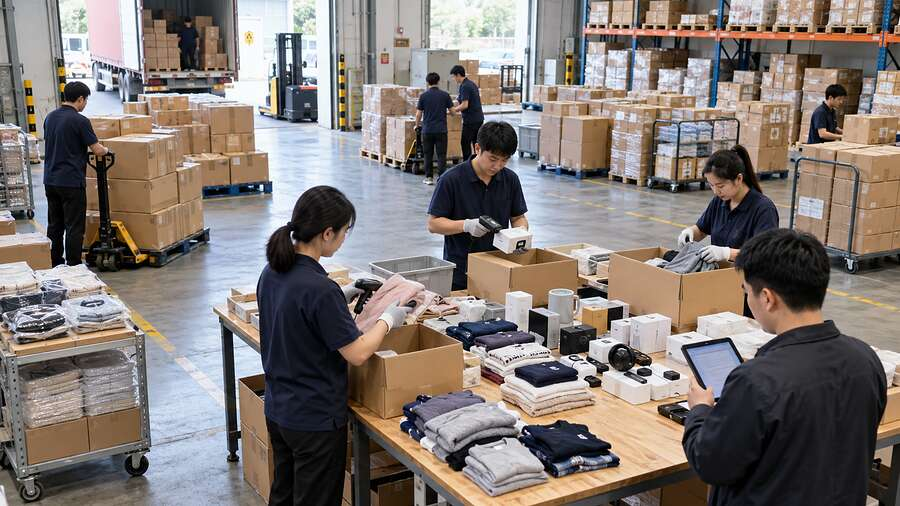
Consolidation brings goods from several suppliers into one controlled shipment. It can reduce duplicate freight, or create a lovely mess if inbound records are weak.
Wait for Complete Inbound Status
Before consolidation, the agent should show the status of every supplier and SKU:
-
ordered quantity;
-
received quantity;
-
inspected or checked quantity;
-
accepted quantity;
-
rejected or held quantity;
-
replacement or return status;
-
storage start date.
Resolve discrepancies before repacking. Original supplier packaging and labels may be needed for a return. Also confirm the free-storage period, start date, and late-supplier policy. Compare the real cost of waiting with sending two batches.
Repack for the Route, Not Just for a Smaller Box
Removing oversized domestic packaging can lower chargeable volume. But repacking should protect the goods and preserve required labels.
Protect the actual product. Ceramics need separation, apparel needs moisture control, and sharp hardware should not touch soft goods. Liquids, powders, magnets, and batteries may require special handling or documents.
For ecommerce orders, consolidation is also the point where you may add branded mailers, inserts, barcode labels, bundles, or retail boxes. Make these choices after the core product is approved. The custom packaging for Shopify dropshipping guide covers those pack-out decisions in more detail.
| Repacking action | Possible benefit | Possible risk |
| Remove empty domestic cartons | Lower volume and fewer boxes | Loss of supplier labels or return evidence |
| Combine inner packs | Easier inventory handling | Mixed SKUs if labels are weak |
| Vacuum-pack soft goods | Lower volume | Creasing, deformation, or trapped moisture |
| Replace weak cartons | Better export protection | Extra material and labor cost |
| Add retail packaging | Brand-ready inventory | Higher volume, MOQ, and artwork risk |
| Build kits | Ready-to-sell bundle | Component shortage or assembly error |
Reconcile Before the Cartons Close
The final packing record should state:
-
carton number;
-
SKU and quantity in each carton;
-
units per inner pack;
-
net and gross weight;
-
external dimensions;
-
barcode or carton-mark status;
-
package photos;
-
special handling or product restrictions.
Freight may use actual or dimensional weight. A light box of pillows can cost more than the scale suggests because it occupies space. Request the final quote from packed-carton data, not bare product weight.

Export Is a Responsibility Map, Not a Shipping Label
Once cartons are ready, name every party touching the export.
| Party | Possible responsibility | Boundary to confirm |
| 1688 seller | Supplies goods and domestic invoice or sales record | Whether it has any export role |
| Sourcing agent | Coordinates order data, warehouse, and providers | Whether it acts as seller, exporter, or only an agent |
| Warehouse | Provides final SKU, carton, weight, and dimension data | Whether it prepares documents or only supplies cargo data |
| Exporter or declarant | Supports China export declaration | Legal entity, declared value/description, and document scope |
| Freight forwarder | Books and manages transport | Origin/destination charges, insurance, and customs services |
| Customs broker | Files entries based on supplied data | Country, entry type, power of attorney, and fee scope |
| Importer of record | Takes legal responsibility for the import | Identity, tax/duty payment, permits, records, and compliance |
| Consignee | Receives the shipment | Whether it is also the importer or merely the delivery party |
Arranging freight does not automatically make the agent the exporter or importer. Ask for legal names.
Build the Document Set From Real Cargo Data
Commercial cargo commonly needs an invoice, packing list, accurate descriptions, values, quantities, origin data, and transport documents. Some products need permits, declarations, tests, or certificates. The documents must match the goods; vague labels such as “accessories” or “gift” may be inadequate. HS classification affects duties, restrictions, and documents, so obtain qualified advice when needed. The agent can organize data, but the importer still carries destination-country obligations.
False values, descriptions, or unexplained importer details can lead to seizure, penalties, denied claims, or missing import records.
Use an Incoterms Rule With a Named Place
ICC’s Incoterms® 2020 rules help allocate costs, risks, and selected obligations between seller and buyer. There are 11 rules, and the chosen rule should be paired with a precise named place.
Writing only “FCA,” “DAP,” or “DDP” invites disagreement. “FCA agent warehouse, Yiwu, China, Incoterms® 2020” is clearer. Incoterms do not certify compliance, replace the sales contract, or settle every title and tax issue.
A DDP quote deserves special care. Ask:
-
Who is the seller under the trade term?
-
What exact destination is named?
-
Who will be the importer of record?
-
Which duties and taxes are included?
-
Are customs exams, storage, remote delivery, or re-delivery excluded?
-
Will the buyer receive compliant import records?
-
What happens if customs requests product documents?
Choose the Route After Final Carton Data Exists
Express may suit small urgent goods, air freight larger time-sensitive cargo, and sea freight heavier orders. Rail or truck may fit certain routes.
The route depends on final dimensions, weight, restrictions, destination, deadline, customs setup, and budget. Compare global shipping options from China after packing data is known.
Carrier liability may be below the goods’ value. Confirm insurance coverage, exclusions, evidence, and claim deadlines.

The Workflow Changes by Product and Sales Channel
One inspection and packing checklist cannot serve every product.
| Category or channel | Controls that deserve extra attention |
| Apparel and textiles | Fabric composition and weight, measurement tolerance, size/color matrix, stitching, shade consistency, labeling, and moisture protection |
| Electronics and batteries | Model and component specification, functional checks, charging/accessories, battery data, transport documents, and destination safety requirements |
| Home, kitchen, and food-contact goods | Material identity, finish, odor, edge quality, coating, food-contact requirements, and applicable testing |
| Beauty and personal care | Ingredient and formula control, batch/expiry data, package compatibility, claims, labels, and destination registration rules |
| Toys and children’s goods | Age grading, small parts, mechanical and chemical hazards, warnings, traceability, and destination testing |
| Pet products | Material, seams, closures, tensile points, size, cleaning instructions, and careful handling of safety claims |
| Amazon FBA | Product labels, carton labels, unit prep, carton dimensions/weight, shipment plan, and current inbound requirements |
| Shopify or private-label inventory | Branded pack-out, SKU accuracy, stock buffer, order processing, tracking, and returns workflow |
An Amazon replenishment may leave the China warehouse in master cartons prepared for an inbound appointment. A Shopify brand may hold the same products in a China 3PL fulfillment service and ship them one by one in branded mailers.
Wholesale buyers may prioritize case packs, spare-parts buyers model traceability, and private-label brands artwork control. Ask about category experience, then request the actual checklist.
A Small Example: Three 1688 Suppliers, One Export Shipment
Imagine a Shopify seller ordering 600 canvas tote bags, 700 printed thank-you cards, and 650 reusable mailers from three 1688 suppliers. This is a hypothetical example, but the workflow is realistic.
The buyer sends one pack-out brief. Each sold unit needs one tote, one card, and one mailer. The agent confirms the tote fabric and print sample, card dimensions and paper, and mailer size and logo.
The cards arrive first. The warehouse records 700 accepted pieces. The mailers arrive next and pass the agreed size and print check. The tote delivery contains 600 units, but 40 use the wrong handle color.
Instead of consolidating everything immediately, the warehouse holds those 40 totes. It sends photos tied to the purchase order. The supplier replaces them during the domestic return period.
After replacement, the warehouse has 600 sellable sets, with 100 cards and 50 mailers left as separate inventory. It assembles kits only if the buyer wants ready-to-ship units.
Final carton records show the actual quantities, dimensions, and gross weights. The forwarder quotes from those figures and prepares the shipment under the agreed responsibility structure.
Consolidation removed two international shipments but not labor, storage, or import costs. Its main value was one reconciled cargo set.

How to Choose and Test a 1688 Sourcing Agent
Ask what happens after you send the link, not only the commission.
Ask for Scope, Evidence, and Exceptions
Ask whether the agent searches or only buys from your links. Confirm access to original quotes, domestic freight, fee and exchange-rate calculations, receiving scope, sample size, inspection reference, reporting time, returns, storage, SKU traceability, final carton data, export declarant, importer expectations, outside-provider access, and cargo-release authority.
Ask for sample operating records with client details removed. You are checking whether the work leaves an evidence trail.
Run a Paid Pilot Before a Large Order
Choose a small order that still represents the real work. If the future order contains five colors and custom packaging, a pilot of one plain unit tests almost nothing.
Measure the pilot with a scorecard:
| Control point | Pass | Conditional | Fail |
| Quote accuracy | All costs and assumptions separated | Small gaps corrected before payment | Unexplained total or changing hidden fees |
| Supplier evidence | Identity and quote traceable | Some details need follow-up | Supplier or beneficiary concealed |
| Receiving | Timely record and correct SKU count | Minor reporting delay | Missing, mixed, or untraceable goods |
| Inspection | Agreed sample and clear report | Useful report with limited gaps | Vague photos and no acceptance basis |
| Problem handling | Issue held and resolved before release | Slow but documented remedy | Goods shipped despite unresolved issue |
| Consolidation | Carton contents fully reconciled | Small data correction needed | Quantity or SKU mismatch |
| Shipping handoff | Final cargo data and scope clear | Exclusions clarified late | Import/export responsibility remains unknown |
One pilot does not prove permanent reliability, but its problem handling can reveal more than a polished sales call.
Watch for These Red Flags
-
The agent hides supplier identity, original price, or fee calculations.
-
The quote is one unexplained total.
-
“Full inspection” has no checklist, sample size, or report format.
-
Goods can be shipped without the buyer’s release approval.
-
Supplier, warehouse, freight, export, and import roles are blurred.
-
The provider suggests false declarations or has no remedy process.
-
The agent pushes a large order before completing a representative pilot.
Local execution can be especially useful when orders involve several sellers and physical warehouse work. If that matches your project, review the scope of a Yiwu sourcing agent service and compare it against the checklist above. The service name matters less than the work it commits to perform.
Conclusion
1688 can give overseas buyers access to a deep domestic wholesale market. The listing price, though, is only the beginning.
A reliable 1688 sourcing agent should turn a loose product request into a controlled chain of work: comparable supplier quotes, traceable payment, recorded receiving, defined inspection, reconciled consolidation, and an export handoff built from real cargo data.
The agent does not remove every risk. No badge proves supplier capability. No random inspection guarantees zero defects. No shipping label removes the importer’s responsibilities.
Start with a representative pilot. Put specifications and service scope in writing. Approve the important handoffs instead of waiting for a tracking number at the end. It may feel slower on day one, but it is usually much faster than fixing the wrong goods after they cross an ocean.
Frequently Asked Questions
Can foreigners buy directly from 1688 without an agent?
Yes. Direct buying can work if you can manage the account, Chinese communication, payment, domestic delivery, defects, and export. Access varies by country and account. Use an agent when you need local purchasing, inspection, consolidation, or shipping coordination.
What does a 1688 sourcing agent actually do?
A full agent may search, compare quotes, confirm specifications, arrange samples, pay sellers, receive and inspect goods, solve discrepancies, consolidate, and coordinate export. A basic buying agent may only purchase from supplied links, so confirm scope.
Is a 1688 buying agent the same as a freight forwarder?
No. A buying agent manages purchases and suppliers; a forwarder manages transport. One company may offer both, plus warehousing and inspection. Still separate the costs, responsibilities, and evidence for each task.
How much does a 1688 sourcing agent charge?
There is no universal fee. Agents may use a percentage, fixed amount, minimum fee, or margins on currency, warehousing, and freight. Compare the complete cost, including domestic shipping, inspection, repacking, storage, export, and delivery.
Can I see the original 1688 supplier price and invoice?
Ask before appointment. A transparent provider should explain access to supplier quotes, domestic freight, and purchase records. For an all-inclusive resale model, require a clear specification, total price, scope, and remedies.
How can an agent verify a supplier found on 1688?
The agent can review platform signals, verify the legal entity and license, match the beneficiary, examine product focus and facilities, arrange an audit, and order samples. Depth should match product risk, customization, and value.
Does a 1688 badge prove the seller is a factory?
No. A badge is a screening signal, not proof that every item is made in-house or meets your specification. Verify the company, supplier role, facilities, capability, sample, and controls.
What is checked when goods arrive at the agent’s warehouse?
Basic receiving may cover parcel identity, damage, SKU labels, and a count. It may exclude sealed-pack opening, measurements, functions, or compliance. Define the checklist and sample size before ordering.
Is warehouse inspection the same as a pre-shipment inspection?
No. Warehouse checks often focus on identity, count, and visible condition after domestic delivery. A formal random inspection uses defined requirements, sampling, defect classes, and acceptance criteria. Confirm which service is included.
Can a 1688 agent inspect every unit?
Some agents arrange 100% sorting for an extra fee. It needs a precise method and does not replace laboratory testing for materials, electrical safety, restricted substances, or other compliance requirements.
Can one agent consolidate products from several 1688 suppliers?
Yes. A controlled process keeps each order and SKU traceable, resolves discrepancies before repacking, records final carton contents, and protects different products correctly.
Does consolidation always reduce international shipping cost?
No. Consolidation may remove duplicate freight minimums and packaging, but adds handling, storage, or repacking. Compare the final consolidated quote with realistic separate shipments and chargeable weights.
What documents are needed to export goods bought on 1688?
Common documents include a commercial invoice, packing list, cargo descriptions, values, quantities, and transport records. Some goods need permits, tests, or certificates. Confirm the exporter, importer, broker, and document owner.
Who is the importer of record when a 1688 agent offers DDP shipping?
Do not assume. Request the importer’s legal identity, named destination, included duties and taxes, entry records, and exclusions. The importer carries obligations for classification, documentation, and applicable product requirements.
Can a 1688 sourcing agent ship to Amazon FBA or fulfill Shopify orders?
Many can, but workflows differ. Amazon needs current prep, labels, carton data, and inbound compliance. Shopify fulfillment needs inventory accuracy, pack-out, processing, tracking, and returns. Test the real workflow before scaling.
Table of Content

I’m Cassiel. I’ll help you scale your Shopify business with reliable fulfillment.
Join to newsletter.
Follow us and get more knowledge.