
You get a 3PL quote: $1.80 for the first item. Nice. Then the first invoice lands. There are extra picks, mailers, an insert charge, and a second shipment for one order that would not fit in a single box. Suddenly, $1.80 feels like the price of the front door, not the whole house.

That doesn’t mean the warehouse is overcharging you. It might be. But you cannot tell from the headline rate. You have to know what event triggers each fee and how often that event appears in your orders.
Let’s take the bill apart. By the end, you should be able to price a one-item order, a multi-item basket, a branded parcel, and a typical month. More usefully, you’ll know what to ask before signing a rate card.
One customer order can create several billable jobs
A customer orders one T-shirt and two jars of skin cream. Your storefront calls that one order. The warehouse sees three physical units, two distinct SKUs, perhaps two pick locations, one carton, and one carrier label. If the jars must travel separately from the shirt, it may also see two parcels.
These numbers are related. They are not interchangeable.
| Count | Meaning on the warehouse floor | Possible billing use |
| Order | One customer purchase or released fulfillment request | Base handling or first-item fee |
| Unit | One physical sellable item | Additional-item fee after the included unit |
| SKU line | One distinct product or variant on the order | Per-line picking under some contracts |
| Pick location | A shelf, bin or stock position visited | Per-location charge in some workflows |
| Parcel | A box or mailer handed to the carrier | Packaging, label and postage |
| Kit | One finished bundle, or loose parts assembled into one | One prebuilt SKU or a separate assembly job |
The usual flow is simple enough: receive an order from Shopify or another channel, find the right stock, scan or verify it, place it in suitable packaging, apply the shipping label, and hand it over. The pick retrieves the item. The pack gets it ready to travel. Some warehouses bundle both into one base price. Others separate pieces of the work.
This article deals with the outbound pick and pack part. Inbound receiving, storage, returns, postage and account fees still affect your total fulfillment cost. Our China fulfillment center fee breakdown maps those surrounding lines if you need the larger budget.
First, though, nail down the billing vocabulary. If a quote says “$0.40 per additional item,” ask whether that means each extra unit, each extra SKU line, or each new location. The answer changes a three-unit order immediately.
What does the first-item fee buy?
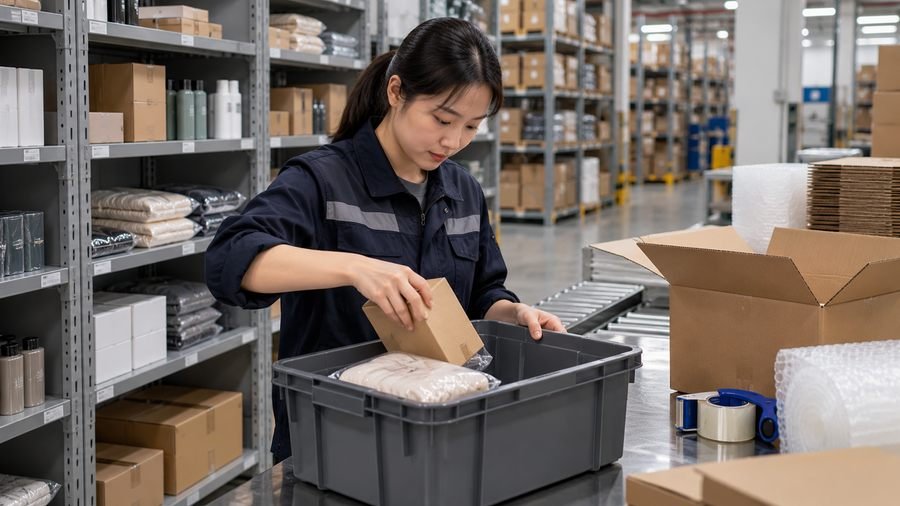
Think of the first-item or base fee as the cost of starting and completing a normal order. Someone has to open the task, get the item, verify it, pack it, and prepare it for dispatch. The labor does not vanish when the basket contains only one product.
But there is no universal contents list for “first item.” One 3PL includes a standard mailer. Another charges for it. A third includes the first few picks. Some quote an order fee and a first-pick fee separately. Those can both be valid structures if the contract explains them.
A published example helps show the shape, not the market average. Flow Fulfillment’s rate card lists $3.90 for a first pick, $0.60 for each additional pick, and $0.40 for its stated pouch-and-mailer packaging. Its three-item example totals $5.50 plus postage. Those are that operator’s published US-dollar rates and inclusions, checked in October 2026. Your quote may look quite different.
For your own quote, get these answers in writing:
-
Is the base fee per customer order, completed shipment, or parcel?
-
Is one unit included, or more than one? What counts as an included pick?
-
Does the price cover scanning, packing labor, a shipping label, tape, and basic materials?
-
When is the fee earned: order release, pick start, pack completion, or carrier handoff?
-
What happens if the order is cancelled or the warehouse makes an error?
If the contract says $2.20 for one completed one-unit order and standard materials cost $0.25 separately, the warehouse activity is $2.45 before postage. It is not $2.20 plus another first-item fee for that same unit. That sounds obvious until a spreadsheet mistakenly bills the first unit twice.
Ask the provider to show a sample line on an invoice. The label “first pick” is less useful than a real order ID and a clear quantity of one.
An “additional item” is a rule about counting
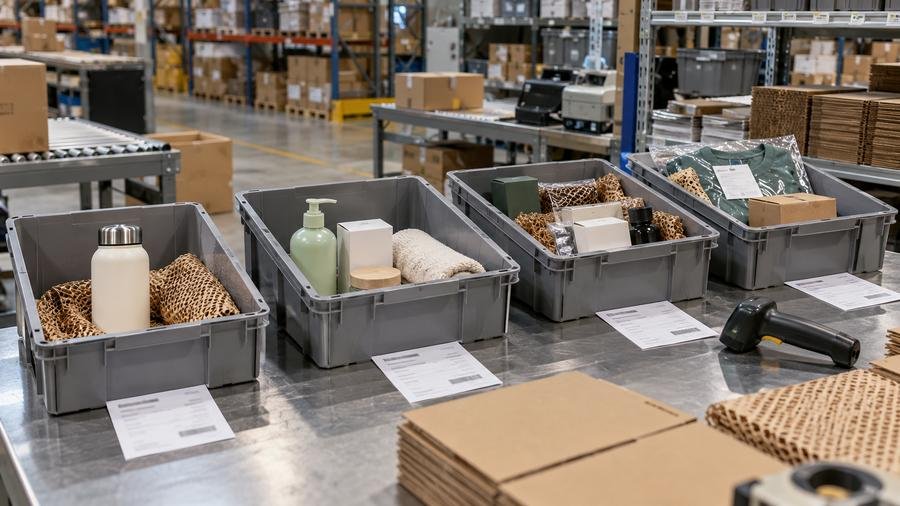
Once the first item is included, the warehouse may charge for the next item in the same order. The fee can be small. Its effect isn’t small if customers routinely buy two or three products.
For a common per-unit model with one included unit:
billable extra units = total units in completed eligible orders − one included unit per order
Calculate this order by order if the contract has different included quantities or split-shipment rules. An empty, cancelled, or never-fulfilled order should not quietly enter the denominator unless the contract bills work already performed.
Three of one SKU versus three different SKUs
Take two orders. Order A contains three identical mugs. Order B contains a mug, a tea strainer, and a box of tea. Each has three units. Under a fee for each unit after the first, both have two additional items.
Under a fee for each distinct SKU line after the first, Order A has zero extra SKU lines and Order B has two. Under a per-location model, the warehouse may visit one location for A and three for B—unless stock is stored in more than one location or one pick route is consolidated. You need the contract’s rule, not a guess about how the aisle looks.
| Basket | Units | Distinct SKU lines | Extra units after one included | Extra SKU lines after one included |
| A + A + A | 3 | 1 | 2 | 0 |
| A + B + C | 3 | 3 | 2 | 2 |
| A + A + B | 3 | 2 | 2 | 1 |
The word “item” could mean either column. Some rate cards also price a case pick, heavy-item pick, or lot-controlled pick differently. If your brand sells apparel variants, each size or color may be a separate SKU. If you sell cosmetics, batch and expiry controls may add verification steps. Make sure the workflow and fee reflect the actual handling requirement.
Kits change where the work happens
Suppose your “morning routine” bundle contains a cleanser, serum and moisturizer. A warehouse might hold it as one preassembled kit SKU. The team assembled it earlier, recorded the three components leaving stock, and now picks one finished kit when an order arrives.
Or it might pick three loose components each time a customer orders the bundle. That’s more outbound picking and perhaps assembly or gift-box labor. Neither approach is automatically cheaper. Pre-kitting moves work earlier and may leave finished bundles sitting in storage if demand changes.
Ask for both routes on the same forecast: kit assembly cost, finished-kit storage, extra-item charges, component inventory records, and what happens if one component runs out. Don’t pay once to build a finished kit and then accept a second “three loose items” charge for shipping that same finished SKU unless the contract really specifies another task.
For this to work, your product master and packing instructions need stable SKUs and a bill of materials. The 3PL onboarding checklist covers the SKU, bundle and scan data that make a pilot invoice meaningful.
A second parcel is not another customer order
A split shipment adds a parcel, packaging and postage. Whether it also adds a second base pack fee depends on the contract and why the split happened. A customer requested separate delivery? A large lamp cannot share a box with fragile glass? Or the warehouse split a normal order because it was out of stock in one location?
Write down the rule for each case. The order ID should link to its shipment IDs and parcel count. A system that turns a backorder into a new fulfillment request can otherwise make the invoice look like two fresh orders.
Inserts, gift notes and fragile wrap may have their own labor charges. They are not automatically “additional sellable items.” Ask for the operational trigger and unit: per insertion, per order, per minute, or per approved special work order.
Packaging has a material bill and a labor bill
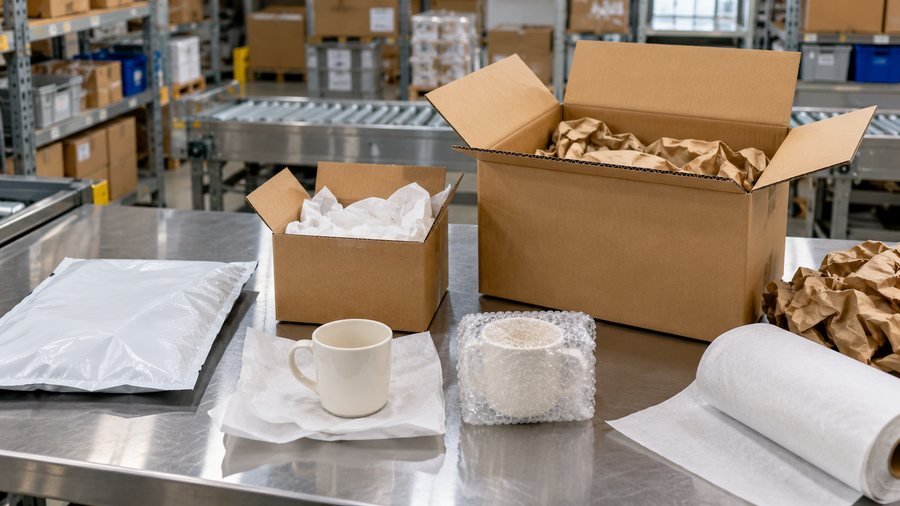
“Packaging included” sounds lovely. Included which package? A thin poly mailer that works for a shirt cannot protect a ceramic mug. And a branded rigid box may add size, storage and a special packing step.
Split the conversation into four parts:
-
Materials: the actual mailer, carton, label stock, tape, void fill or branded component.
-
Application labor: choosing the package, placing the product, adding protection, applying an insert and sealing it.
-
Packaging inventory: buying, receiving, storing, counting and replacing branded materials.
-
Shipping effect: the final packed weight and dimensions used for carrier pricing.
| Material or instruction | Question for the rate card | Where a separate cost might appear |
| Standard poly mailer | Which sizes are included, if any? | Per-order material line |
| Corrugated carton | Are box sizes and void fill priced separately? | Box plus protective materials |
| Branded sleeve or box | Who buys it and owns unused stock? | Supplier purchase, receiving and storage |
| Printed card or gift note | Is placing it part of normal packing? | Material plus application |
| Fragile protection | Which handling steps and photos are required? | Approved special handling and material |
A separate “pack fee” and “packaging material” line are not automatically duplicate billing. One may pay for a person’s work; the other may pay for the box. But if the base already promises a standard mailer, the same mailer shouldn’t be billed again without an agreed exception. Match the contract wording to the material consumption record.
Custom packaging can create a second trap. Your printer may sell 2,000 branded mailers while you ship only 700 orders this month. Cash spent on 2,000 mailers differs from materials consumed by 700 parcels. The remaining stock is an asset if it stays usable. If the brand changes its artwork next month, it may become waste. Track both numbers.
Show the pack station an approved physical sample and a short, photo-based SOP. Where does the insert sit? Which face of the box gets the label? May the team substitute a plain mailer when branded stock runs out? The custom packaging workflow for Shopify goes into those production and pack-out decisions.
Then measure the packed parcel. A thicker gift box may raise dimensional weight and carrier charges even when the warehouse’s labor fee is unchanged. That is how a ten-cent packaging decision can cost far more than ten cents. Different carrier rules and destinations apply, so quote with your actual dimensions.
Put a month’s orders through two rate cards
Time for a small spreadsheet without the spreadsheet headache. These are invented teaching figures, not quotes from either cited provider, FriendDropshipping prices, or market averages.
Assume one month contains:
-
600 completed one-unit orders.
-
300 completed two-unit orders.
-
100 completed three-unit orders.
-
One parcel and one standard package per order, no kits, special handling, cancellations or split shipments.
That’s 1,000 orders and 1,500 units. If the first unit is included in each base fee, you have 500 billable additional units: 300 from the two-unit orders and 200 from the three-unit orders.
| Illustrative rate component | Quote A | Quote B |
| Base per completed order, first unit included | $2.20 | $1.80 |
| Each additional unit | $0.40 | $0.75 |
| Standard packaging materials per parcel | $0.25 | $0.65 |
| Base for 1,000 orders | $2,200 | $1,800 |
| Extra units: 500 × extra-unit fee | $200 | $375 |
| Materials for 1,000 parcels | $250 | $650 |
| Outbound activity total, excluding postage | $2,650 | $2,825 |
| Outbound activity per completed order | $2.65 | $2.825 (about $2.83) |
B wins the headline: its base is 40 cents lower. A wins this month’s modeled outbound bill by $175. The higher extra-unit and material charges wipe out B’s lower base. If the store sold only single-item orders, the comparison would change. That’s why your order mix belongs in the quote.
Now imagine the contract charges extra SKU lines, not extra units. We need more data. Assume the 300 two-unit orders include 180 orders with two of the same SKU and 120 with two distinct SKUs. Among the 100 three-unit orders, 40 have one SKU, 40 have two, and 20 have three.
There are 200 extra SKU lines beyond the first: 120 from the two-unit group and 80 from the three-unit group. At the same hypothetical numeric add-on rates, A’s extra-line charge would be $80 and B’s $150. Totals would be $2,530 and $2,600, respectively. This is a sensitivity exercise, not a claim that a provider would charge the same rate for an SKU line and an extra unit. Ask for both the definition and the actual rate.
A branded insert might add, say, a hypothetical $0.12 material and $0.15 application fee for each order that needs one. For 400 eligible orders, that’s $108 if neither element is included: 400 × ($0.12 + $0.15). Don’t spread it over all 1,000 orders if only 400 receive the insert. And don’t add a second application fee when the base contract explicitly includes one insert.
These totals leave out postage, receiving, storage, returns, account charges and any monthly minimum. For the full picture, model those separately, then divide by the number of successfully fulfilled orders. The Shopify fulfillment cost guide shows how the warehouse and carrier lines fit into delivered-order economics.
One benchmark for context: 3PL Hub’s 2026 pricing analysis reports a $1.85 median order fee with the first pick included and $0.35 median extra-unit pick in its own sample of US domestic fulfillment bids from 17 RFPs, 2023–2026. Those medians describe that sample. They are not a China 3PL rate, a quote for your SKU mix, or a reason to ignore included services.
What if the minimum changes the winner?
Say a contract has a $3,000 monthly minimum against specified qualifying warehouse activity. If A’s $2,650 and B’s $2,825 both qualify in full, the provider would bill a $350 top-up on A and a $175 top-up on B. Both reach $3,000 for that billing pool. Your apparent $175 advantage disappears under those assumptions.
But minimums are not standardized. Some exclude packaging or postage. Some are an additional account charge, while others are only a floor against certain fees. Ask for a worked low-volume invoice. It is easier than arguing about the phrase “monthly minimum” after your first quiet month.
Compare quotes with one order file, then audit the invoice
Send each 3PL the same anonymized order sample or a careful forecast: order count, units, SKU combinations, product weights and dimensions, parcel destinations, packages, inserts, kits, fragile items and return rate. Ask them to run it through their proposed terms and give you the calculation.
| Check | Question to resolve before signing | Evidence after launch |
| Base count | Completed order, released order or parcel? | Order status, shipment IDs |
| Extra picks | Per unit, SKU line or location? How many included? | Order-item lines and WMS pick records |
| Materials | Which standard sizes are included or itemized? | Packaging SKU consumption |
| Custom work | Is the insert, gift wrap or fragile task approved? | Versioned SOP and work record |
| Shipping | Is postage separate, marked up or adjusted later? | Carrier label and settled charges |
| Minimum | Which fees count toward the floor? | Contract and monthly minimum calculation |
| Credits | Who pays for warehouse-caused rework or reship? | Exception ticket, adjustment or credit |
At month end, export completed orders from your store and the 3PL’s WMS. Count the eligible base events. Sum units after each order’s included quantity. Compare packaging consumption with actual parcel types. Match manually approved work to tickets. Then reconcile those counts to invoice lines before debating whether a dollar rate is fair.
Ask for a dispute window long enough to review settled shipping adjustments. Have the 3PL explain how cancellations are treated after picking starts, how replacements are charged, and when a warehouse-caused mispick receives a credit. A sample invoice during onboarding is useful precisely because it turns soft promises into arithmetic.
One more thing: if a system labels the same order “fulfilled” twice during a retry, you may be looking at duplicate records rather than two customer shipments. The warehouse should have an order ID, shipment ID and scan trail that makes that clear.

Lower the bill without removing the checks that matter
The cheapest path is often a tidy operation. Give the warehouse clean SKUs, scannable barcodes, reliable dimensions, clear pack rules, and stock that is easy to locate. A shirt with five inconsistent product names takes longer to handle than a shirt with one identifier.
Right-size the package around the product. For a soft garment, a suitable mailer may beat a box. For a fragile mug, a cheap mailer is false economy. Consider pre-kitting a bundle that sells often, but compare assembly, storage and leftover-kit risk against on-demand picks. Do not turn every possible combination into a finished kit just to dodge a 40-cent extra pick.
Preserve verification when it prevents expensive mistakes. A scan that catches the wrong size may cost seconds and save a reship, return, damaged customer trust and another packing job. The worthwhile metric is not the lowest labor line; it is the cost of an accurate delivered order.
If your inventory is sourced and packed in China, price the actual China-side receiving, branded packing, international line and destination. US domestic fee benchmarks cannot be pasted onto a China quote. A scoped China 3PL fulfillment service should describe what happens to the stock and the customer parcel before assigning a price.
Conclusion
A pick-and-pack quote is a set of counting rules. The first-item fee starts the order; additional-item fees depend on what “item” means; packaging may contain material, application and inventory costs. Run your own order mix through those rules.
Get a sample invoice, test a small live batch, and reconcile it against order and WMS records. Once the charges make sense, you can negotiate the work that actually moves your cost—not just the most visible number on the rate card.
FAQs
What is included in a 3PL first-item fee?
Usually some combination of the first pick, order handling, verification and packing labor. Labels or standard materials may be included or separate. Ask the 3PL to define the exact inclusions and billing trigger in writing.
Is pick-and-pack billed per order or per item?
Often both: a base per eligible order plus an extra charge after an included number of units. Other contracts use per-SKU, per-location or per-parcel rules. Read the unit of measure on the rate card.
Does the first-item fee include only one pick?
It may include one or several. Ask the 3PL to calculate one-, two- and three-unit orders so you can see where the add-on starts.
Do extra units of the same SKU incur a fee?
Under a per-extra-unit rule, yes. Under a per-extra-SKU-line rule, three units of the same SKU may count as one line. The contract decides.
Is an extra SKU different from an extra unit?
Yes. Two identical items are two units and one SKU line. Two different items are two units and two SKU lines. The distinction matters when the provider prices by line or location.
What if one customer order ships in two parcels?
Expect at least two sets of parcel materials and carrier charges. A second base handling fee depends on your agreement and the reason for the split. Link both shipments to the original order.
Are boxes and mailers included in pick-and-pack?
Sometimes standard sizes are. Custom boxes, extra protection or a different mailer may be separate. Ask for the approved materials schedule, not just the word “included.”
Is branded packaging a material or labor charge?
It can involve both. The brand may buy the box and pay for storage, while the warehouse charges to apply a special insert or assemble the pack. Clarify which ordinary packing labor the base already covers.
Are inserts and gift notes additional items?
They may be billed as application tasks rather than sellable-unit picks. Check whether one insert is included and whether material, printing and placement are separate.
Do kits cost more to pick and pack?
They can. A preassembled kit moves work to an earlier assembly stage. A kit built per order takes more outbound handling. Compare total assembly, picking, storage and leftover-stock costs.
Does a 3PL charge for a cancelled order?
It depends on when the cancellation arrives and what work began. Agree on the cancellation cutoff and any pick, repack or restock charge before going live.
Are shipping labels and postage included?
A label may be part of the packing workflow, while carrier postage is often billed separately. Ask about rate basis, markups, adjustments and extra parcels.
How does a monthly minimum change cost per order?
If qualifying fees fall below the contractual floor, a top-up can raise your effective monthly cost. Ask which charges qualify and divide the actual monthly bill by completed orders.
How do I calculate my store’s pick-and-pack cost?
Multiply eligible orders by the base fee, add billable extra units or lines at their contracted rate, then add applicable materials and approved work. Use your own order mix, not an average basket guessed from memory.
How do I audit a pick-and-pack invoice?
Match its base quantity to eligible orders, its extra-pick count to order lines, materials to packed parcels, and special work to approvals. Investigate differences by order and shipment ID within your dispute window.
Table of Content

I’m Cassiel. I’ll help you scale your Shopify business with reliable fulfillment.
Join to newsletter.
Follow us and get more knowledge.